

When brewing coffee with a French press, the coffee-to-water ratio is key to achieving your preferred flavor. Ratios are expressed as "1:X", where 1 gram of coffee is matched with X grams of water. Here's a quick overview of popular ratios:
- 1:10 – Bold and concentrated, great with milk or as a cold brew base.
- 1:12 – Strong but slightly less intense, perfect for a robust morning cup.
- 1:15 – Balanced and full-bodied, ideal for everyday brewing.
- 1:16 – Lighter and subtle, highlighting delicate flavors.
- 1:20 – Mild and smooth, offering a tea-like texture.
Each ratio influences strength, body, and flavor, so experiment to find what suits your taste. Start with 1:15 or 1:16 for a balanced brew, and adjust as needed. Use a digital scale and medium-coarse grind for consistency.
Tip: Steep for 4 minutes, decant immediately, and adjust grind size or water temperature to refine your cup.
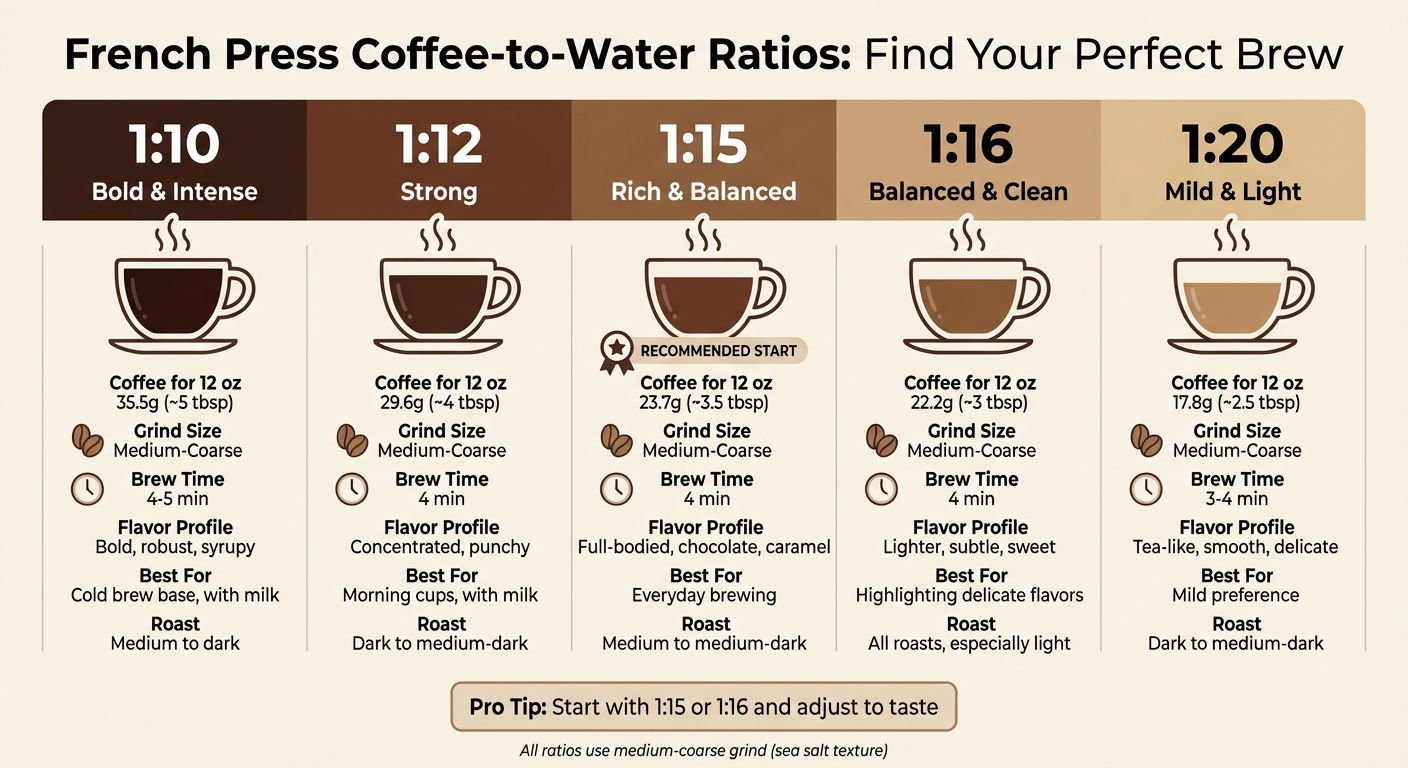
French Press Coffee-to-Water Ratios Comparison Guide
1. 1:10 Ratio for Bold, Heavy Brews
Strength and Flavor Profile
The 1:10 coffee-to-water ratio creates a powerfully concentrated brew, resulting in a dense, syrupy cup with a rich, intense mouthfeel. Thanks to the full-immersion brewing method, this ratio delivers maximum body and depth of flavor [1][5].
"French press coffee is dense and heavy, yet it has its own sort of elegance." - Blue Bottle Coffee [3]
This bold ratio shines when paired with milk or cream, as its strong flavor holds its own against these additions [1]. It's also a favorite for crafting cold brew concentrates, which are typically steeped at room temperature for 12–18 hours [1].
The robust profile of this ratio complements a variety of roast levels and grind adjustments, making it a versatile choice for coffee enthusiasts.
Recommended Coffee and Water Measurements for Common Cup Sizes
| Cup Size | Water Volume | Coffee Weight (1:10 Ratio) |
|---|---|---|
| Small Cup (8 oz) | 237 g | 23.7 g |
| Standard Mug (10 oz) | 296 g | 29.6 g |
| Large Mug (12 oz) | 355 g | 35.5 g |
| Extra Large (16 oz) | 473 g | 47.3 g |
For the best results, precise measurements are key. Next, let’s explore how roast levels can influence the flavor when using this ratio.
Suitability for Different Roast Levels
The choice of roast plays a significant role in fine-tuning the flavor of a 1:10 brew.
Medium and medium-dark roasts are particularly well-suited for this ratio. The immersion method highlights their natural chocolate, caramel, and nutty notes beautifully [1]. Dark roasts can also work, but they might lean toward bitterness or an ashy flavor at this concentration. To counteract this, lower the water temperature slightly to 199–201°F (93–94°C) to avoid over-extraction [1].
"Bold and dark [roasted coffees] hold up so well in a French press. Get a bit fancy and add some milk. Perfection!" - Iaisha Munnerlyn, Educator and Coffee Consultant, Tradecraft Coffee & Tea [2]
Light roasts, however, can lose their bright, tea-like qualities when brewed at such a strong concentration, making them less ideal for this method.
Ideal Brewing Time and Grind Size
For the best results, steep your coffee for 4 minutes using a medium-coarse grind, similar in texture to flaky sea salt. Once the steeping is complete, decant immediately to prevent over-extraction [1][2][4][5]. If the brew tastes overly bitter or ashy, consider using a slightly coarser grind or lowering the water temperature [1][4].
These adjustments can make all the difference in achieving a perfectly balanced cup.
sbb-itb-ed7145d
Five (Easy!) Tips For Better French Press Coffee
2. 1:12 Ratio for Strong Morning Cups
If you're looking for a strong but slightly less intense coffee than the 1:10 ratio, the 1:12 ratio is an excellent choice. It delivers a bold, robust cup that’s perfect for mornings when you need an extra kick.
Strength and Flavor Profile
This ratio creates a concentrated, full-bodied brew that highlights the coffee's natural oils and unique character [2][3][4][5].
"If you want your coffee to pack more punch, try a more concentrated ratio." - Iaisha Munnerlyn, Educator and Coffee Consultant [2]
Thanks to its rich flavor, the 1:12 brew pairs wonderfully with milk or cream, maintaining its strength and complexity [5].
Recommended Coffee and Water Measurements for Common Cup Sizes
To get the perfect brew, follow these coffee-to-water measurements for different cup sizes:
| Cup Size | Water Volume | Coffee Weight (1:12 Ratio) |
|---|---|---|
| Small Cup (8 oz) | 237 g | 19.8 g |
| Standard Mug (10 oz) | 296 g | 24.7 g |
| Large Mug (12 oz) | 355 g | 29.6 g |
| Extra Large (16 oz) | 473 g | 39.4 g |
For a larger batch, like a 1-liter French press, you'll need about 83 grams of coffee [4]. These precise measurements ensure consistency and allow you to adjust the brew to your preferences.
Suitability for Different Roast Levels
The 1:12 ratio works particularly well with dark and medium-dark roasts. These roast levels bring out rich chocolate, caramel, and nutty tones, complemented by the heavier body typical of French press coffee [1][2]. The immersion brewing method naturally enhances these flavors without introducing excessive bitterness.
If you find dark roasts tasting ashy or overly bitter, try shortening the brew time by 15–20 seconds or using a slightly coarser grind [1]. While light roasts can be used with this ratio, their delicate floral and tea-like notes may not shine as brightly at this strength [1][2].
Ideal Brewing Time and Grind Size
For the best results, use a medium-coarse grind - think flaky, like sea salt - and steep for 4 minutes [2][3][4]. Heat your water to 200°F–205°F (93°C–96°C) [1][4]. Start with a bloom: pour twice the weight of the coffee in water, let it rest for 30 seconds to release CO₂, then add the remaining water [2][4]. Once the brew is done, plunge and decant immediately to avoid over-extraction [2][3].
3. 1:15 Ratio for Balanced Everyday Brewing
The 1:15 coffee-to-water ratio strikes a perfect balance for daily brewing, offering a flavor profile that’s neither too bold nor too mild. This ratio is particularly well-suited for French press brewing, delivering a full-bodied cup that highlights the natural oils and unique character of your coffee beans without overwhelming your palate.
Strength and Flavor Profile
With this ratio, you can expect a rich, full-bodied brew featuring notes of chocolate, caramel, and nuts. The lack of a paper filter allows the coffee's natural oils to shine through, giving the cup a dense and satisfying texture. Whether you're brewing a single cup or preparing coffee for a group, this method ensures a consistently enjoyable experience.
"Since there are no paper filters involved, French press brews a cup which retains all of the coffee's natural oils, resulting in a very full bodied and rich cup." - César Pérez, Coffee Expert [5]
Coffee and Water Measurements for Common Cup Sizes
Here’s a quick guide to help you measure coffee and water for different serving sizes:
| Cup Size | Water Volume | Coffee Weight (1:15 Ratio) |
|---|---|---|
| Small Cup (8 oz) | 237 ml | 15.8 g |
| Standard Mug (12 oz) | 355 ml | 23.7 g |
| Large Mug (16 oz) | 473 ml | 31.5 g |
| Extra Large (20 oz) | 591 ml | 39.4 g |
For a full 1-liter French press, use about 67 grams of coffee. You can tweak the strength by slightly adjusting the coffee or water amounts - add more coffee for a stronger brew or more water for a milder taste.
Best Roast Levels for This Ratio
Medium and medium-dark roasts work particularly well with this ratio, as they bring out the coffee's natural sweetness and body. Dark roasts can also shine, but using slightly cooler water (200–203°F or 93–94°C) can help avoid ashy or burnt flavors. Light roasts are an option too, though they might require a finer grind to enhance their sweetness and complexity.
Brewing Time and Grind Size
For the best results, use a medium-coarse grind, resembling the texture of coarse sea salt. Heat your water to 205°F (96°C) for optimal extraction. Follow these steps for a balanced brew:
- Bloom the coffee for 30–45 seconds to release trapped gases.
- Let the coffee steep for 4–5 minutes.
- Once you plunge, immediately pour the coffee into your mug or a carafe to stop further extraction and avoid bitterness.
This ratio is a great starting point for everyday brewing. Once you're comfortable, you might want to experiment with lighter profiles, like the 1:16 ratio, to explore even more subtle flavor nuances.
4. 1:16 Ratio for Lighter, Subtle Tastes
The 1:16 ratio aligns with the Specialty Coffee Association's standard for a lighter French press brew [7]. By using slightly more water compared to the 1:15 ratio, it creates a gentler cup that accentuates delicate and nuanced flavors.
Strength and Flavor Profile
This ratio delivers a balanced body that feels lighter than the richer, heavier texture of a 1:15 brew [1]. The result is a cup with sweet, chocolatey tones, a clean finish, and minimal sediment. If you find traditional French press coffee too bold or intense, the 1:16 ratio offers a softer alternative. The additional water helps spread out the extracted flavors, making it easier to detect subtle tasting notes without overwhelming the palate.
Recommended Coffee and Water Measurements for Common Cup Sizes
To brew with the 1:16 ratio, use the following measurements for typical serving sizes:
| Cup Size | Water Volume | Coffee Weight (1:16 Ratio) |
|---|---|---|
| Small Cup (8 oz) | 237 ml | 14.8 g |
| Standard Mug (12 oz) | 355 ml | 22.2 g |
| Large Mug (16 oz) | 473 ml | 29.6 g |
| Extra Large (20 oz) | 591 ml | 37 g |
For a 1-liter French press, you'll need 62 g of coffee. Next, let’s explore how this lighter ratio complements different roast levels.
Suitability for Different Roast Levels
This ratio pairs especially well with dark roasts, as it softens their bitterness and smoky undertones [8]. Medium roasts also shine with this method, offering a balanced cup with chocolatey sweetness. Light roasts, though more delicate, reveal floral and tea-like clarity, making this ratio ideal for showcasing fruity or herbal notes [1][6][8].
Ideal Brewing Time and Grind Size
Precision matters when brewing with the 1:16 ratio. Use a medium-coarse grind, similar in texture to coarse sea salt, and heat your water to 195°F–205°F (90°C–96°C). Aim for a steeping time of 4–5 minutes, with light roasts benefiting from the full 5 minutes to ensure complete extraction [1][9]. Once brewing is complete, plunge and decant immediately to halt further extraction.
5. 1:20 Ratio for Mild, Smooth Cups
The 1:20 ratio is the go-to option for a milder French press brew, delivering a smooth, light-bodied cup that’s almost reminiscent of tea in texture [1]. This method uses more water, resulting in a gentler brew - perfect for anyone who finds traditional French press coffee a bit too bold [2]. The added dilution emphasizes smoothness without overwhelming flavors.
Strength and Flavor Profile
This ratio produces a light, tea-like flavor, a stark contrast to the richer, syrupy consistency of a 1:15 brew [1]. If you find stronger ratios too intense, the 1:20 ratio offers a much softer alternative. As Iaisha Munnerlyn, an Educator and Coffee Consultant at Tradecraft Coffee & Tea, advises: "If the coffee tastes too intense or overpowering, try a ratio with more water, like 1:17 or 1:18" [2]. The 1:20 ratio takes this idea to the next level, creating an even smoother experience.
Coffee and Water Measurements for Common Cup Sizes
Here’s how much coffee and water you’ll need for typical cup sizes when using the 1:20 ratio:
| Cup Size | Water Volume | Coffee Weight (1:20 Ratio) |
|---|---|---|
| Small Cup (8 oz) | 237 ml | 11.9 g |
| Standard Mug (12 oz) | 355 ml | 17.8 g |
| Large Mug (16 oz) | 473 ml | 23.7 g |
| Extra Large (20 oz) | 591 ml | 29.6 g |
For a full 1-liter French press, you’ll need 50 g of coffee.
Best Roasts for This Ratio
Dark and medium-dark roasts shine with the 1:20 ratio. Their bold, rich flavors remain balanced and enjoyable even with the extra water [1][2]. The higher dilution also helps tone down any bitterness or ashy notes that can sometimes occur with darker roasts in immersion brewing [1][2]. On the other hand, light roasts may not work as well here - they often end up tasting thin or sour when brewed at such a high dilution [1].
Brewing Tips: Time and Grind Size
For the best results, use a medium-coarse grind, similar to coarse sea salt, and heat your water to 200°F–205°F (93°C–96°C) [1][4]. Steep the coffee for 4 to 5 minutes, adjusting the time based on your roast choice: darker roasts typically require less time, while lighter beans need the full 5 minutes to avoid sourness [1][3]. Once brewing is complete, transfer the coffee immediately to a carafe or mug to prevent over-extraction and bitterness [3][2]. Check out the ratio comparison table below for a quick look at how this ratio stacks up against others.
Ratio Comparison Table
This table simplifies key brewing ratios, offering a quick reference for measurements and flavor profiles. Each ratio creates a unique taste experience, ranging from bold and intense to light and delicate.
| Ratio | Strength Level | Coffee for 12 oz | Coffee for 24 oz | Grind Size | Brew Time | Flavor Characteristics |
|---|---|---|---|---|---|---|
| 1:10 | Bold and intense | 35.5 g (~5 tbsp) | 71 g (~10 tbsp) | Medium-Coarse | 4–5 min | Bold, robust flavor |
| 1:12 | Strong | 29.6 g (~4 tbsp) | 59.2 g (~8.5 tbsp) | Medium-Coarse | 4 min | Concentrated and punchy; great with milk |
| 1:15 | Rich & balanced | 23.7 g (~3.5 tbsp) | 47.3 g (~6.5 tbsp) | Medium-Coarse | 4 min | Rich, syrupy, full-bodied |
| 1:16 | Balanced, clean, everyday | 22.2 g (~3 tbsp) | 44.4 g (~6 tbsp) | Medium-Coarse | 4 min | Balanced and clear |
| 1:20 | Mild & light | 17.8 g (~2.5 tbsp) | 35.5 g (~5 tbsp) | Medium-Coarse | 3–4 min | Milder, subtle, tea-like |
For a 1:10 ratio, adding an extra minute of brew time can enhance extraction, delivering an even bolder taste. On the other hand, the 1:20 ratio works well with a shorter brew time of around 3 minutes, creating a lighter, tea-like profile.
Kieran from Above Average Coffee offers a great perspective: "A 1:14 ratio will taste much stronger than a 1:17 cup. One isn't better than the other it just depends on what... flavor you enjoy." [10]
This chart underscores how tweaking the ratio influences not just the strength but also the texture of your brew, especially when using a premium French press coffee maker. Whether you're after a rich, concentrated cup or something more subtle and delicate, the choice is entirely yours.
Conclusion
When it comes to French press brewing, the magic lies in personalization. Your perfect coffee-to-water ratio depends on your taste preferences. Whether you lean toward the bold richness of a 1:10 ratio or enjoy the delicate, tea-like nuances of a 1:20 brew, each ratio offers a unique flavor profile. The beauty of the French press is its flexibility - by simply tweaking the coffee amount, you can control the strength, body, and flavor of your cup.
A good starting point is a 1:15 or 1:16 ratio, and from there, you can fine-tune by adjusting ±1 gram per 300 ml of water until you find your ideal balance. Consistency is essential for replicating your favorite brew, so using a digital scale is a game-changer. Pair that with a high-quality burr grinder to achieve evenly ground coffee and avoid the gritty texture uneven grounds can produce.
Having the right tools makes experimenting with your French press not only easier but also far more enjoyable. Fwing Coffee offers a range of premium brewing tools, from digital scales that measure with 0.1g precision to burr grinders that deliver consistent, coarse grounds. These tools turn your brewing process into a reliable, repeatable ritual.
At the end of the day, the best ratio is the one that delights your taste buds every morning. Don’t hesitate to stray from standard guidelines - craft a cup of coffee that’s as unique as your preferences.
FAQs
What’s the best coffee-to-water ratio for French press brewing?
The coffee-to-water ratio is a key factor in determining the flavor profile of French press coffee. A higher ratio - meaning more coffee and less water - results in a bold, intense brew. On the other hand, a lower ratio creates a lighter, smoother cup.
A good place to start is with a 1:16 ratio: 1 gram of coffee for every 16 grams of water. This translates to about 2 tablespoons of coffee for every 6 ounces of water. From there, you can tweak the ratio to suit your taste. Prefer a stronger brew? Try a 1:15 ratio. Looking for something milder? Go for 1:17. These small adjustments give you the flexibility to craft a cup that matches your preferences perfectly.
Playing around with these ratios isn’t just practical - it’s part of the joy of brewing, letting you find that ideal balance for your perfect cup.
What grind size should I use for different coffee-to-water ratios in a French press?
For brewing coffee with a French press, stick to a coarse grind - think of the texture of sea salt or kosher salt. This grind size is key for proper extraction, as it allows water to flow evenly through the coffee grounds while avoiding over-extraction, which can result in bitter or overly muddy flavors.
Whether you like your coffee strong with a 1:10 ratio or prefer a milder cup at 1:16, the grind size should always stay coarse. This consistency helps deliver a balanced, rich flavor. For the best results, consider using a burr grinder. Unlike blade grinders, burr grinders provide a more uniform grind, which is crucial for crafting the perfect French press coffee.
Why should you pour French press coffee into another container right after brewing?
When you brew coffee with a French press, transferring it to another container immediately after brewing is a must. Leaving the coffee in contact with the grounds for too long leads to over-extraction, which can make your coffee taste bitter and leave it with a gritty texture. By pouring it out right away, you lock in the coffee’s smooth, rich flavor, giving you a consistently enjoyable cup.