

Choosing the right coffee maker depends on your brewing preferences, budget, and routine. Here’s how to simplify the process:
- Brewing Style: Do you prefer espresso, drip, French press, or cold brew? Each method offers a unique flavor and experience.
- Capacity: Single-serve machines are great for individuals, while multi-cup models suit larger households or frequent drinkers.
- Budget: Coffee makers range from under $50 for basic models to $500+ for premium machines with advanced features.
- Features: Look for essentials like temperature control, thermal carafes, and programmable settings. Advanced options include built-in grinders and SCA certification for quality assurance.
Quick Overview
| Method | Flavor Profile | Brew Time | Best For |
|---|---|---|---|
| Drip | Smooth, medium body | 5–10 mins | Consistent daily coffee |
| Espresso | Rich, concentrated | 1–3 mins | Quick shots, milk-based drinks |
| French Press | Bold, full-bodied | 4–10 mins | Heavy, rich flavor |
| Pour-Over | Clean, nuanced | 3–5 mins | Single cups, flavor exploration |
| Cold Brew | Smooth, low acidity | 12–48 hours | Iced coffee, low-acid options |
| Moka Pot | Strong, robust | 5 mins | Intense stovetop coffee |
| AeroPress | Clean, versatile | 1–2 mins | Portability, quick brewing |
Key Tip: Consider long-term costs like coffee pods, filters, and maintenance when deciding. The best coffee maker complements your daily habits and delivers your preferred taste every time.
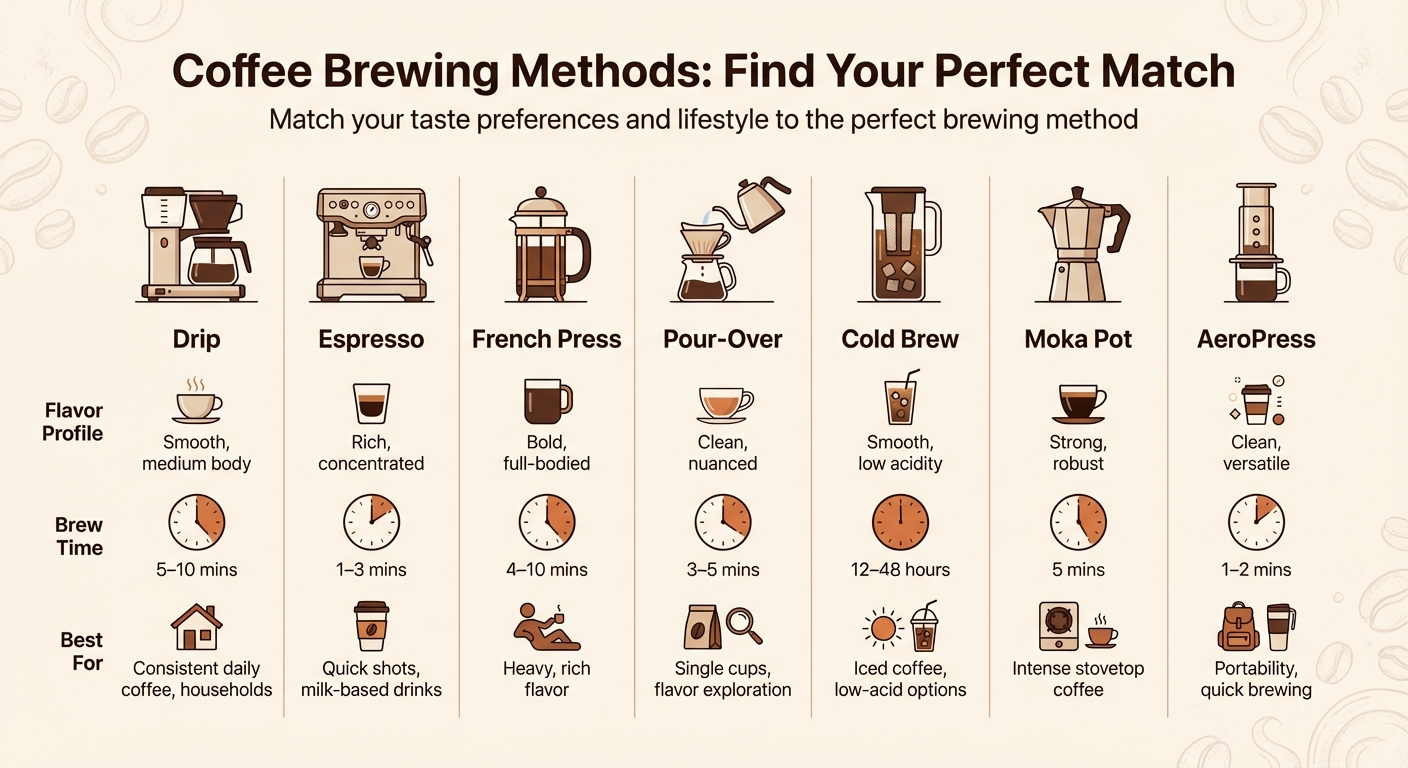
Coffee Brewing Methods Comparison: Flavor, Time, and Best Uses
How to Choose the Best Coffee Machine in 2025 (Everything You Need to Know!)
Identify Your Brewing Preferences
Picking the perfect coffee maker starts with understanding your favorite flavor profile. Do you lean toward a bold and full-bodied brew, or do you prefer something clean and nuanced? Each brewing method offers a distinct taste, and knowing what you love can help you zero in on the right choice.
Lisa McManus sums it up perfectly:
"There are so many ways to make coffee... Each kind of brewer makes a distinctly different cup of coffee and takes varying amounts of effort, money, time, and space." [1]
Think about whether you enjoy a rich, intense brew or a lighter, more delicate cup. Also, consider how much time and effort you’re willing to put into your daily coffee ritual.
Common Brewing Methods Explained
Here’s a quick rundown of popular brewing methods and the unique flavors they deliver:
- Automatic Drip Machines: Found in many American kitchens, these produce smooth, medium-bodied coffee when brewed at 195°F to 205°F. The flavor is consistent, though it may lack the depth of manual methods [7][8].
- Espresso Machines: These create rich, concentrated shots topped with crema. They require skill and often a significant investment, with prices starting around $500 [7].
- French Press: Known for its bold, full-bodied brew, this method uses immersion and a metal mesh filter to deliver a heavy texture in about 4 minutes [1][8].
- Pour-Over: Using tools like the Chemex or Hario V60, this method employs paper filters to trap oils and sediment, resulting in a clean, light-bodied cup that highlights subtle aromas. As Melitta explains:
"Paper absorbs some of the oils from the beans, which can interfere with the taste." [8]
- Cold Brew: Steeping grounds in cold or room-temperature water for 12 to 48 hours creates a smooth, creamy concentrate with low acidity. It’s perfect for those sensitive to acidic coffee, though it requires planning ahead [4].
- Moka Pot: This stovetop brewer uses steam pressure to produce a strong and complex cup. While not true espresso, it delivers an intense flavor. McManus describes it as a notably robust brew [1].
- AeroPress: Combining immersion and pressure, the AeroPress delivers a clean, concentrated cup with minimal bitterness. It’s fast - brewing takes just 10 to 60 seconds - and has earned top marks in flavor tests [8].
Match Brewing Methods to Your Taste
Once you’ve identified your preferences, it’s easier to match them to a brewing method:
- If you’re after low acidity and smoothness, cold brew is ideal. Its lack of heat prevents the extraction of harsh acidic compounds [5].
- For a crisp, clean flavor, go for a pour-over with paper filters, which remove oils that might overshadow delicate notes [8].
- If you love a heavy, full-bodied cup, a French press or Moka pot will give you that rich mouthfeel by allowing more oils and micro-grounds into your coffee [1].
- For busy mornings, programmable drip machines or pod-based systems offer quick brewing with minimal cleanup [4].
- Coffee lovers who enjoy the process might prefer a manual pour-over, which lets you fine-tune every detail - bloom time, water temperature, and flow rate. Just remember, as Donna Currie points out:
"manual pour-over coffee makers... all require your full attention for that perfect cup" [5]
Here’s a quick guide to help you match brewing methods with flavor and convenience:
| Method | Flavor Profile | Brew Time | Best For |
|---|---|---|---|
| Drip | Smooth, medium body | 5–10 mins | Households, consistent daily coffee |
| Espresso | Intense, concentrated | 1–3 mins | Milk drinks, quick shots |
| French Press | Bold, full-bodied | 4–10 mins | Rich flavor without filters |
| Pour-Over | Clean, bright | 3–5 mins | Single cups, flavor exploration |
| Cold Brew | Smooth, low acidity | 12–48 hours | Iced coffee, sensitive stomachs |
| Moka Pot | Robust, sharp | 5 mins | Strong stovetop coffee |
| AeroPress | Clean, concentrated | 1–2 mins | Portability, versatility |
Determine the Right Capacity for Your Needs
Picking the right size coffee maker boils down to how many people you're brewing for and how much coffee you actually drink. Just as different brewing styles cater to unique tastes, the capacity of your coffee maker should align with your drinking habits. A machine that's too small means constant refills, while an oversized one wastes space and energy.
For individuals or couples who drink just 1–2 cups a day, a single-serve machine or a compact 1–2 cup drip coffee maker is a practical choice [4]. On the other hand, larger households or heavy coffee drinkers will benefit from automatic drip machines that brew 10–14 cups [4].
Single-Serve vs. Multi-Cup Brewing
Single-serve machines are perfect when you need speed and variety. They brew one cup at a time with minimal cleanup, making them ideal for busy mornings or households where everyone prefers different flavors. For example, the Keurig K-Elite comes with a 75-ounce water reservoir, allowing you to make about six 12-ounce drinks before needing a refill [10]. However, keep in mind that pods tend to cost more per cup [4][2].
Multi-cup drip machines are better suited for groups or families. They're great for entertaining or for households where coffee is enjoyed throughout the day. If you frequently host guests, a machine with a thermal carafe can keep coffee warm for hours without the burnt taste that hotplates often leave [4][2]. Some dual coffee makers even combine a full carafe option with a single-serve side, offering flexibility for different needs [4][2].
One thing to note: brewing a single cup in a large coffee maker can lead to weaker coffee since the machine isn’t optimized for small batches [2]. If you occasionally brew less, look for machines with a "small-batch" or "1–4 cup" setting to maintain flavor quality [3].
Your brewing preferences will guide you toward the right capacity, but there’s more to consider when it comes to how manufacturers label their machines.
Advertised Capacity vs. Actual Volume
When choosing a coffee maker, keep in mind that the term "cup" in coffee maker specs doesn’t mean a standard 8-ounce cup. Instead, it usually refers to a smaller 5–6 ounce serving [4][11]. As Althea Chang-Cook from Consumer Reports explains:
"Most large models brew 10 to 14 cups, although typically, when drip coffee makers refer to cups of coffee, their 'cup' is only 5 to 6 ounces, not a full 8 ounces." [4]
So, a "12-cup" coffee maker actually produces about 60 to 72 ounces of coffee, which equals only 7.5 to 9 standard 8-ounce servings [11]. If you’re using a 12-ounce travel mug, that same "12-cup" carafe will only give you 5 to 6 servings [11].
To figure out how many servings you’ll get, measure your favorite mug and do some quick math. Multiply the advertised cup capacity by 5 or 6 (for ounces), then divide by your mug size [11].
| Advertised Capacity | Actual Volume | Standard 8oz Servings | 12oz Mug Servings |
|---|---|---|---|
| 5 cups (Small Drip) | 25–30 oz | 3–4 | 2–3 |
| 10 cups (Standard) | 50–60 oz | 6–8 | 4–5 |
| 12 cups (Large) | 60–72 oz | 8–9 | 5–6 |
| 14 cups (Extra Large) | 70–84 oz | 9–11 | 6–7 |
Set a Budget and Evaluate Long-Term Value
When buying a coffee maker, the initial price tag is just the beginning. A $50 drip machine might seem like a bargain, but the ongoing costs of paper filters and electricity can add up over time. On the other hand, a $500 espresso machine could save you money in the long run by replacing those daily coffee shop visits. The key is to look beyond the upfront cost and consider the total lifetime expenses. To help, it’s useful to break coffee makers into price tiers for a clearer comparison.
Coffee Maker Pricing Tiers
Coffee makers generally fall into three price categories, each with its own set of features and durability levels:
- Budget models (under $50): These provide basic drip functionality, with some reliable options starting as low as $13 [4][14]. However, they’re typically made of plastic, offer minimal features, and tend to last only 2–3 years [15].
- Mid-range machines ($100–$200): These come with upgrades like programmable timers, stainless steel components, and interactive displays [4]. For example, the Cuisinart PerfecTemp, priced around $120, includes features like an integrated grinder and a thermal carafe to keep coffee hot without burning it [4][14].
- Premium models ($200–$500+): These top-tier machines boast built-in grinders, advanced brewing modes, and high-quality construction [4][14]. Options like the Fellow Aiden ($369) and Ratio Six ($339) meet Specialty Coffee Association standards and include 3–5 year warranties [6]. With proper care, these machines can last 5–10 years [15].
Ongoing Costs and Maintenance
The price of the coffee maker itself is just part of the equation - recurring expenses can vary widely depending on your brewing habits. For instance:
- Coffee costs: Ground coffee runs about $0.32–$0.48 per cup, while name-brand pods cost $0.60–$1.15 per cup (store-brand pods are cheaper at $0.28–$0.56). Brewing three cups daily adds up to an annual cost of $383–$821 for ground coffee versus $307–$1,259 for pods [15]. Using a reusable mesh filter can eliminate paper filter costs entirely [15].
- Energy usage: A standard 1,200-watt drip coffee maker running for two hours daily uses about 72 kWh per month, costing approximately $10.08 at an average rate of 14¢/kWh [16]. In contrast, single-serve pod machines use 1,500 watts but only run about 10 minutes per day, costing just $1.05 monthly [16]. Turning off warming plates after brewing is another simple way to save on energy costs.
-
Maintenance: Regular upkeep is essential to avoid costly repairs. For example, descaling solutions can prevent mineral build-up that might otherwise lead to repair bills exceeding $500 in hard water areas [13]. As Field Service Solutions explains:
"Regular maintenance of your coffee machine substantially prolongs its operational life while also helping you save money over time." [12]
Skipping maintenance can even void warranties, as many manufacturers require proof of regular servicing [12]. Investing in routine care not only keeps your machine running smoothly but also ensures you get the most out of your warranty.
sbb-itb-ed7145d
Evaluate Key Features and Certifications
When choosing a coffee maker, it's not just about sticking to your budget - it’s about finding a machine that delivers great coffee consistently. While extra features can sometimes complicate things without improving your brew, focusing on the essentials ensures you get the most out of every cup.
Must-Have vs. Nice-to-Have Features
Think about how you brew coffee and prioritize features that actually make a difference. For example, temperature precision is critical. The ideal brewing temperature is between 195°F and 205°F, which ensures proper extraction [6]. Lower-cost machines often struggle to maintain this range, but many mid-range and high-end models use PID controllers for precise temperature management.
A thermal carafe is another must-have. Unlike glass carafes that sit on warming plates (which can overheat coffee and ruin its flavor), thermal carafes keep your coffee at a drinkable temperature - above 110°F - for up to four hours [6]. This is perfect if you like to enjoy your coffee slowly or brew a full pot to last through the morning.
Convenience features like programmable timers, pause-and-serve functions, and removable water reservoirs can make your morning routine smoother [9]. Some machines even come with built-in burr grinders, ensuring your beans are ground fresh right before brewing [9]. If you’re serious about flavor, look for a bloom function, which pre-wets the coffee grounds to improve extraction [6].
Quality Certifications Explained
If you want a coffee maker that’s guaranteed to deliver professional-level results, look for the Specialty Coffee Association (SCA) Certified Home Brewer mark. This certification means the machine has passed rigorous tests for temperature stability, proper brew time, and even extraction [17][18]. As Whole Latte Love puts it:
"Being an SCA Certified Home Brewer means that these coffee makers consistently make great-tasting coffee." [18]
SCA certification isn’t just a one-time stamp of approval. Manufacturers pay an annual fee and submit their machines for periodic re-testing to ensure they continue to meet the association’s high standards [17]. Machines like the Technivorm Moccamaster KBT and the Breville Precision Brewer (priced around $329.95) are prime examples. The Breville even includes a "Gold" preset that aligns with SCA brewing guidelines [18].
For those who want to take their brewing setup to the next level, Fwing Coffee (https://fwingcoffee.com) offers precision kettles and grinders designed to complement top-tier coffee makers.
When shopping, keep an eye out for the SCA logo on the product box or webpage. Consumer Reports evaluates over 150 coffee makers on brew temperature and contact time, but SCA certification simplifies the process by guaranteeing consistent performance [4]. This is especially helpful in the $200–$400 range, where machines like the OXO Brew 8-Cup provide certified quality at a more accessible price point [1].
Match Your Coffee Maker to Your Lifestyle
The coffee maker you choose should fit seamlessly into your daily routine, living space, and brewing preferences. Whether you savor the process of crafting the perfect cup or need a quick caffeine fix on busy mornings, your lifestyle can help narrow down the options. A machine that’s perfect for a leisurely weekend morning might not work as well for a fast-paced weekday routine.
Coffee Makers for Small Spaces
When counter space is at a premium, the size of your coffee maker matters. For instance, the Nespresso Essenza Mini is just 3.3 inches wide, making it one of the slimmest electric machines out there [19]. Another compact option is the OXO Brew 8-Cup, which is 7 inches wide and versatile enough to brew both single mugs and full carafes without taking over your counter [19]. Coffee reviewer Cheyenne Elwell puts it perfectly:
"Counter space is prime real estate in my kitchen. I have to be intentional about what earns a spot, and bulky appliances rarely make the cut." [19]
If you prefer manual brewing, options like the AeroPress or Chemex can be tucked away in cabinets when not in use, freeing up valuable counter space [19]. Just make sure to measure the open-lid height of any machine to ensure it fits under your cabinets [4]. For smaller households, look for coffee makers with a "1–4 cup" setting, which slows the water flow for better flavor extraction when brewing smaller amounts [19][7].
If your mornings are more about speed than space, you’ll need a machine that prioritizes convenience.
Convenience for Busy Schedules
When time is tight, features like speed and automation become essential. Programmable coffee makers and single-serve systems can brew your coffee quickly with minimal cleanup, ensuring your cup is ready when you are [2][4]. A popular option is the Keurig K-Elite, which has racked up an impressive 4.6-star rating on Amazon from over 69,500 reviews [20].
If you like to sip your coffee over several hours, a thermal carafe is a better choice than a glass one with a warming plate. As author Jessica Easto explains:
"If you are looking to preserve coffee flavor quality, it's better to never let the coffee get cold in the first place, such as with a thermal carafe." [21]
For added convenience, look for machines with built-in grinders, which save time and counter space by grinding fresh beans directly before brewing [2][3]. And for the ultimate in ease, Wi-Fi-enabled machines like the Fellow Aiden (priced around $350–$400) let you start brewing from your smartphone - perfect for those mornings when you don’t want to leave bed just yet [21].
Options for Coffee Enthusiasts
For those who love experimenting with every detail of their brew, manual coffee makers are the way to go. These allow you to control grind size, water temperature, and steeping time, giving you the freedom to fine-tune your cup [7][22].
If you want precision but prefer an automated system, the Breville Precision Brewer (priced around $323–$330) is an excellent choice. It lets you adjust the water temperature to the exact degree and customize bloom times. The Fellow Aiden also stands out by using temperature profiling to replicate manual pour-over techniques. Licensed Q Arabica Grader Asser Christensen shares his insight:
"The Breville Precision Brewer feels like an espresso machine wearing a drip costume... packed with controls: PID temperature adjustment, selectable flow rates, programmable bloom. The Aiden forced me to reconsider what an automatic brewer can do... I get cups surprisingly similar to a really good pour over here." [23]
For those who dream of café-quality espresso at home, semiautomatic machines like the Lelit MaraX (around $1,700) offer the hands-on experience of pulling your own shots and steaming milk [7]. It’s perfect for anyone who enjoys the ritual of crafting their coffee as much as drinking it.
Conclusion
Finding the perfect coffee maker starts with understanding what matters most to you. Your brewing method plays a big role in the flavor you’ll enjoy - whether it’s the deep, robust taste from a French press or the crisp, smooth profile of a drip coffee machine. Don’t forget to consider how much coffee you drink daily to pick the right capacity.
Cost is another key factor to weigh. While pod machines are convenient, the price of capsules can add up over time, making traditional brewing with ground coffee a more budget-friendly option. As food writer Donna Currie wisely points out:
"Making coffee at home saves you a bundle." [5]
If you’re investing in a pricier machine, look for durable materials like stainless steel and check for solid warranties to ensure it lasts.
For those with busy mornings or limited counter space, programmable or single-serve models are great choices. On the other hand, if you love experimenting with brewing techniques, manual or precision machines might be more your style. And if your kitchen has tight spaces, be sure to measure your counters and cabinet clearance before buying.
Ultimately, the best coffee maker isn’t about having the most features or the lowest price - it’s about finding one that complements your lifestyle and brewing preferences. By taking the time to evaluate your needs, you’ll end up with a machine that fits seamlessly into your daily routine, delivering great coffee and enhancing your mornings for years to come.
FAQs
What’s the best way to choose between a single-serve and a multi-cup coffee maker?
Deciding between a single-serve coffee maker and a multi-cup model comes down to your coffee habits, the size of your household, and how much you value convenience versus customization.
Single-serve machines are compact, fast, and designed to brew one cup at a time with almost no cleanup. They’re a great fit for individuals or households where everyone has unique preferences for coffee flavors or strengths. However, these machines often use pods, which can be pricier per cup and may not deliver the same depth of flavor as freshly ground beans.
On the other hand, multi-cup coffee makers are perfect if you regularly make several cups at once - whether for a family, guests, or your daily caffeine fix. They let you use your own ground coffee, which is usually more budget-friendly and gives you more control over flavor. While they do take up more counter space and take longer to brew, they’re ideal for anyone who enjoys making larger batches.
Consider your lifestyle: If you’re all about speed and simplicity for just one person, a single-serve machine might be your best bet. But if you love brewing multiple cups and experimenting with coffee beans, a multi-cup maker is probably the way to go. Whichever you choose, Fwing Coffee has premium tools and accessories to help you make the most of your coffee experience at home.
What are the long-term costs of owning different types of coffee makers?
The cost of owning a coffee maker over time largely depends on the type you go for. A standard drip coffee maker is a budget-friendly choice, with an upfront cost ranging from $20 to $150 and monthly electricity expenses of about $10 to $12.
If you’re leaning toward convenience, single-serve pod machines are an option, though they come with a higher price tag. These machines typically cost $80 to $200 and consume about $12 to $15 per month in electricity.
For those who take their coffee seriously, a home espresso setup is a bigger commitment. Expect to spend anywhere from $700 to $3,000 for the machine and grinder. But here’s the upside: by skipping those daily café runs, you could recover the initial investment in 1 to 2 years and save as much as $2,000 to $3,000 annually on coffee shop drinks.
Ultimately, the best choice depends on your budget, how you like your coffee brewed, and how often you make it at home.
What is SCA certification, and why does it matter when choosing a coffee maker?
SCA certification is a trusted seal of approval from the Specialty Coffee Association, given to coffee makers that meet rigorous brewing standards. These standards cover critical factors like maintaining the right water temperature, achieving the ideal brew time, and ensuring consistent extraction - key elements for crafting an excellent cup of coffee.
Opting for an SCA-certified coffee maker means you're choosing a machine built to deliver top-notch, dependable results, bringing the café experience straight to your kitchen.