

The grind size of coffee beans directly impacts flavor by controlling how water extracts compounds like acids, sugars, and bitters. A finer grind increases surface area, speeding up extraction, while a coarser grind slows it down. The goal is to balance extraction for a flavorful cup - avoiding sourness from under-extraction or bitterness from over-extraction. Matching grind size to your brewing method (e.g., espresso, French press, cold brew) ensures optimal results. Consistency in grind size, achieved with a burr grinder, is crucial for even flavor extraction and a well-balanced brew. Fine-tune your grind to suit your taste preferences, and keep notes for consistent results.
Coffee Grind Size Explained: Why Your Coffee Tastes Bad!
sbb-itb-ed7145d
Grind Size Basics
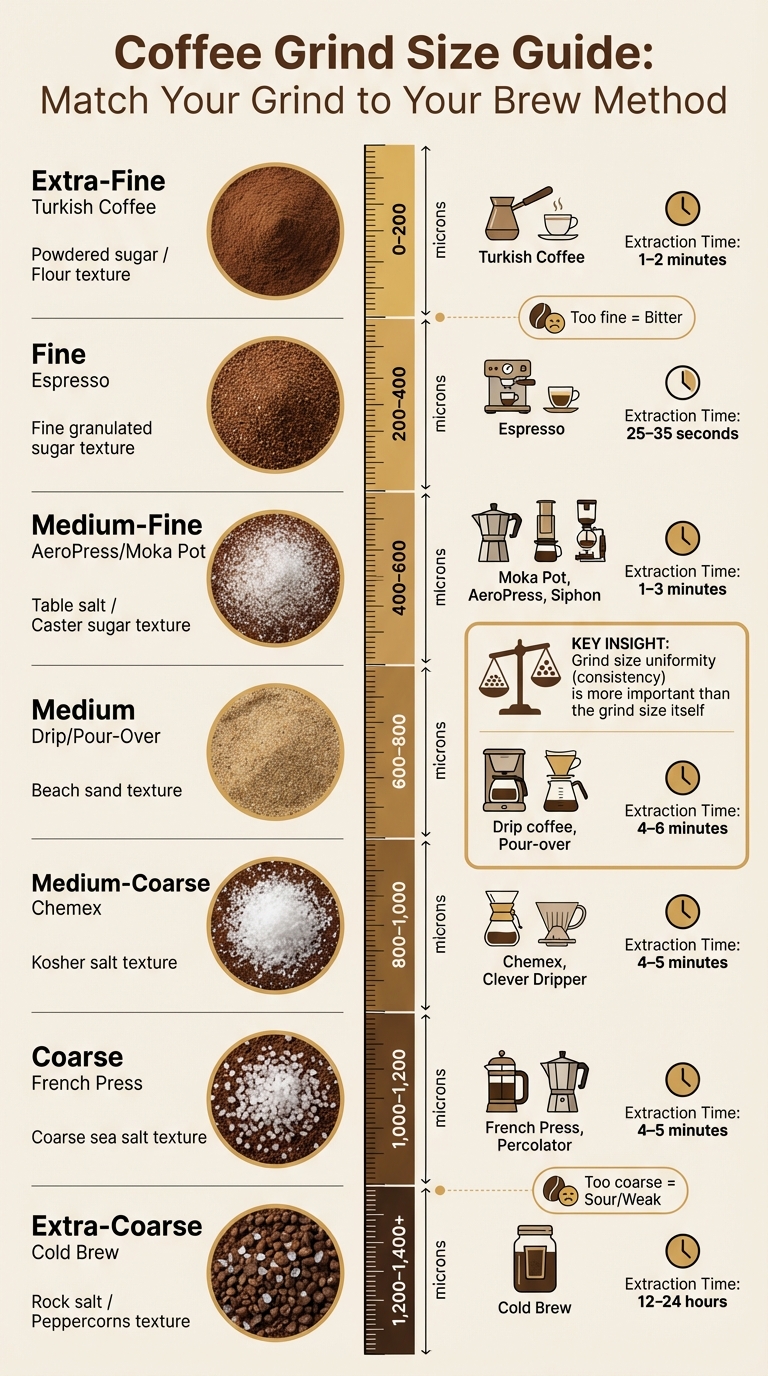
Coffee Grind Size Chart: Brewing Methods and Particle Sizes
Grind size plays a crucial role in coffee brewing, directly affecting how flavors are extracted. To put it simply, grind size refers to the average particle size of ground coffee, measured in microns (μm) or millimeters (mm). Picture it like this: the texture of rock salt, beach sand, or powdered sugar - each representing a different grind size [4][7].
"Grind size is the invisible gatekeeper that determines whether any of those elements [origin, roast, brewing] actually show up in the cup." - Achilles Coffee Roasters [1]
Why does grind size matter so much? It determines three key factors: surface area, water resistance, and extraction speed. These elements work together to shape how your coffee brews. By understanding these basics, you’ll be better equipped to match grind size to specific brewing methods for optimal results.
Types of Grind Sizes
There are seven main grind size categories, each tailored to a particular brewing method and extraction time. Think of them as a roadmap for achieving the perfect cup.
| Grind Category | Particle Size (Microns) | Appearance | Best Brewing Method |
|---|---|---|---|
| Extra-coarse | 1,200–1,400+ | Rock salt / Peppercorns | Cold Brew |
| Coarse | 1,000–1,200 | Coarse sea salt | French Press, Percolator |
| Medium-coarse | 800–1,000 | Kosher salt | Chemex, Clever Dripper |
| Medium | 600–800 | Beach sand | Drip coffee, Pour-over |
| Medium-fine | 400–600 | Table salt / Caster sugar | Moka Pot, AeroPress, Siphon |
| Fine | 200–400 | Fine granulated sugar | Espresso |
| Extra-fine | 0–200 | Powdered sugar / Flour | Turkish Coffee |
Each grind type has its place. Extra-coarse grinds, resembling rock salt, are best for cold brew, which requires steeping for 12–24 hours [6]. Coarse grinds, similar to sea salt, work well for French press brewing, which takes about 4–5 minutes. Medium grinds, with a sandy texture, are ideal for drip coffee and pour-over methods. Fine grinds, akin to granulated sugar, are essential for espresso, which extracts in just 25–35 seconds under high pressure. Meanwhile, extra-fine grinds, as powdery as flour, are reserved for Turkish coffee.
Matching the grind size to the brewing method ensures you extract the right flavors at the right pace, giving you control over the final cup.
Why Consistency Matters
While choosing the correct grind size is important, consistency is even more critical. When coffee grounds are uniform in size, water extracts flavor compounds evenly, resulting in a balanced and clean-tasting cup [10].
"Grind size uniformity (consistency) is by far more important than the grind size itself - whether brewing for espresso or pour over." - Scott Rao and Chahan Yeretzian, Coffee Professionals [5]
Inconsistent grinding leads to two problems: fines (tiny particles that over-extract, causing bitterness) and boulders (large chunks that under-extract, leaving sourness and a thin body) [10]. When both are present, the result is a disjointed flavor profile - a cup that tastes both sour and bitter [1].
The best way to achieve consistency is by using a burr grinder instead of a blade grinder. Blade grinders chop beans unevenly, much like a food processor, creating a mix of fines and boulders. Burr grinders, on the other hand, crush beans between two abrasive surfaces (flat or conical), producing uniform particles. This precision ensures predictable, repeatable extractions, allowing the unique characteristics of your coffee to shine through [4]. For home brewers seeking professional-level results, burr grinders like this travel-friendly electric burr grinder are a great investment.
Consistency in grind size is the foundation for mastering coffee extraction, setting the stage for a flavorful and well-balanced cup every time.
How Grind Size Affects Extraction
Grind size plays a key role in how coffee flavors are extracted, directly influencing how water interacts with the coffee grounds during brewing.
Extraction is the process where water dissolves the flavor compounds locked inside coffee grounds. Grinding breaks open the coffee bean, exposing these compounds to water. The smaller the coffee particles, the more surface area they provide for water to extract flavors.
"Grind size is the master control of coffee brewing because it simultaneously governs how fast flavors dissolve and how water moves through the coffee bed." – Something's Brewing [2]
Flavors are extracted in a specific order - starting with bright, acidic notes, followed by sweet sugars, and finally bitter alkaloids. Timing is everything; you want to capture the best flavors while avoiding over-extraction, which can lead to bitterness [2][3].
Surface Area and Extraction Speed
The size of the coffee grind directly impacts how quickly extraction happens. Think of granulated sugar versus a sugar cube: the granules dissolve faster because they have more surface area. The same concept applies to coffee. Fine espresso grinds (200–400 microns) expose significantly more surface area than coarse French press grinds (1,100–1,300 microns), allowing espresso to fully extract in just 25–30 seconds under pressure [6][8][9].
Grind size also affects water flow in brewing methods like pour-over or espresso. Finer grinds pack tightly, creating resistance that slows water flow and increases contact time. Coarser grinds, on the other hand, allow water to pass through more quickly, reducing contact time and leading to a slower, more gentle extraction [2][6].
When grind size doesn’t match the brewing method, it can lead to extraction issues. If the grind is too coarse, water flows through too quickly, extracting only acidic compounds and leaving the coffee tasting sour or thin. If the grind is too fine, water spends too much time in contact with the grounds, pulling out bitter compounds and resulting in a harsh, dry cup [1][6][9].
To correct sour coffee, try grinding finer to increase surface area and slow the water flow. For bitter coffee, grind coarser to reduce surface area and speed up extraction. Mastering this balance between surface area and water flow allows you to fine-tune flavors with precise grind adjustments [2][6][9].
Matching Grind Size to Brewing Methods
Every brewing method has its own grind size sweet spot, and nailing it can make or break your cup of coffee. The grind size directly influences how water interacts with the coffee grounds, affecting extraction time and flavor. By tailoring the grind to your brewing device, you can ensure a well-balanced cup every time. Let’s dive into how grind size pairs with popular brewing methods.
Grind Size by Brewing Method
Espresso calls for a fine grind, about the texture of granulated sugar (≈0.3 mm). This grind creates enough resistance to extract rich flavors in 25–35 seconds under 9 bars of pressure [6]. If the grind is too coarse, water flows too quickly, resulting in sour, weak coffee. Too fine, and the excessive resistance can lead to over-extraction and a bitter taste.
For pour-over methods, grind size depends on the specific device:
- The Hario V60 works best with a medium-fine grind, resembling table salt. Its thin filter allows quick drainage, so a finer grind balances the flow.
- The Chemex requires a medium-coarse grind, similar to rough sand. Its thick paper filter slows the flow, making a coarser grind ideal.
- The Kalita Wave typically uses a medium grind, akin to beach sand. Its flat-bottom design ensures even extraction with this texture.
The French press thrives on a coarse grind (≈1 mm, sea-salt texture). This consistency prevents over-extraction during the 4-minute immersion and minimizes sediment, thanks to the metal mesh filter.
Cold brew needs an extra-coarse grind, about the size of rock salt (≈1.5 mm). With steeping times ranging from 12 to 24 hours, the prolonged contact ensures full extraction even with large coffee particles.
The AeroPress is versatile, accommodating medium-fine to fine grinds depending on the recipe and steeping time. Adjust the grind based on your preferred brew strength and flavor profile.
Brewing Method Comparison Table
Here’s a quick reference to match grind size with brewing methods, along with common flavor pitfalls to watch out for:
| Brewing Method | Ideal Grind Size | Visual Consistency | Extraction Time | Flavor Pitfalls |
|---|---|---|---|---|
| Cold Brew | Extra-Coarse | Rock salt | 12–24 hours | Bitter if too fine; weak if too coarse |
| French Press | Coarse | Sea salt | 4–5 minutes | Muddy or harsh if too fine; thin if too coarse |
| Chemex | Medium-Coarse | Rough sand | 4–5 minutes | Stalled flow and bitterness if too fine |
| Drip Coffee | Medium | Beach sand | 4–6 minutes | Flat or watery if too coarse |
| Pour-Over (V60) | Medium-Fine | Table salt | 2.5–4 minutes | Sour or fast flow if too coarse |
| AeroPress | Medium-Fine to Fine | Fine salt | 1–3 minutes | Highly variable based on recipe |
| Espresso | Fine | Granulated sugar | 25–35 seconds | Choked or bitter if too fine; sour if too coarse |
| Turkish | Superfine | Flour | 1–2 minutes | Gritty or bitter if not powdery enough |
Even a small tweak - just 50–100 microns - can dramatically impact your brew, especially with pour-over methods [5]. Use these guidelines as a starting point, but always adjust based on taste. If your coffee leans sour or thin, try a finer grind. If it’s bitter or harsh, go coarser.
Looking for tools to perfect your grind? Check out the expertly curated selection at Fwing Coffee.
Grind Size and Flavor Characteristics
Grind size plays a dual role in coffee brewing: it controls extraction and determines which flavor notes take center stage in your cup. Coffee compounds dissolve in a predictable order - acids and salts come first, followed by sugars and oils, and finally bitter alkaloids and tannins. This sequence means how fine or coarse you grind your coffee directly impacts which flavors dominate. Let’s take a closer look at how grind size influences acidity, sweetness, body, and aroma.
Acidity and Sweetness
A coarser grind tends to highlight bright acids, resulting in a lively and vibrant cup. However, if the grind is too coarse, you may extract mostly acids without enough sugars to balance them, leaving the coffee with a sharp or "hollow" taste. On the other hand, a finer grind allows for deeper extraction, drawing out more sugars and oils. This enhances sweetness and smooths out the acidity, but going too fine can bring out late-stage tannins, which can overpower the cup with bitterness.
The goal is to find that "sweet spot" where acidity and sugars are perfectly balanced. For light roasts, which are denser and slower to extract, a slightly finer grind often works best. Dark roasts, being more brittle and soluble, usually require a coarser grind to avoid over-extraction and an ashy or overly bitter finish.
Body and Aroma
Grind size doesn’t just affect flavor - it also shapes the texture and aroma of your coffee. Finer grinds extract more lipids and sugars, resulting in a thicker, syrupy mouthfeel and a more pronounced aroma. This is why espresso, which uses a fine grind, delivers such a rich, intense experience. But there’s a trade-off: grinding too fine can lead to a "muddy" cup, where bitter notes overshadow the subtler aromatics.
In contrast, coarser grinds produce a lighter, tea-like body with less aromatic complexity. The reduced surface area means fewer oils and solids are extracted, leading to a cleaner but sometimes "thin" or "watery" brew. If your coffee tastes sour or lacks body, try grinding finer. If it’s too bitter or harsh, adjust to a coarser setting.
Grind size is a powerful tool for customizing your coffee’s flavor, texture, and aroma, making it a key factor in brewing the perfect cup.
Adjusting Grind Size for Your Taste
Now that we've explored how grind size impacts coffee extraction, it's time to take the next step: fine-tuning your grind to match your personal preferences.
Dialing in your grind is all about experimentation. As Juliet Han, Lead Roaster at Blue Bottle Coffee, puts it:
"You're the boss in deciding what you enjoy." [11]
How to Fine-Tune Your Grind
Start by focusing solely on your grind size. If you're using a new coffee or trying out a different grinder, set your grinder to the middle of its range as a starting point [11].
One effective method is the three-cup comparison: brew one cup at your current setting, then adjust the grind 1–2 clicks finer for one cup and 1–2 clicks coarser for another. Compare the flavors. If the coffee tastes sour or feels thin, it’s likely under-extracted - try grinding finer. If it tastes bitter, it’s over-extracted - grind coarser [12]. Keep in mind that lighter roasts, which are denser, often need a finer grind, while darker roasts generally work better with a coarser setting to avoid bitterness.
For precision and consistency, consider investing in a high-quality burr grinder, like those available at Fwing Coffee.
Once you've made adjustments, taste the results and take notes to replicate your success.
Recording Your Results
A systematic approach can make a big difference. Keep a brewing log where you record details like grind setting (e.g., "80 clicks"), bean variety, water temperature, brew time, and flavor notes [12]. Todd Goldsworthy, US Brewer's Cup Champion at Klatch Coffee, highlights the importance of this practice:
"Finding the right grind setting is simply about testing, tasting, documenting what you did, and changing one variable at a time, until you get a delicious cup." [3]
Pay attention to how flavors hit your palate. Sourness, often felt on the sides of your mouth, indicates under-extraction, while bitterness at the back of your tongue suggests over-extraction. Visual cues during brewing can also guide you: if water drains too quickly through your pour-over, the grind might be too coarse; if it flows too slowly or stalls, the grind is likely too fine. These observations can help you refine your process and achieve consistently great results.
Each small tweak brings you closer to brewing the perfect cup.
Conclusion
Grind size is one of the most effective ways to control the flavor of your coffee. Think of it as the steering wheel that guides which compounds - like acids, sugars, or bitters - make their way into your cup [1]. With this understanding, you can fine-tune every brew to suit your taste.
When you adjust the grind, you’re directly influencing how flavors extract. Finer grinds, with their larger surface area, slow the flow of water and extract flavors more quickly, often resulting in a richer, bolder taste. On the other hand, coarser grinds allow water to flow faster, creating lighter, more delicate brews.
Learning to adjust your grind size transforms coffee brewing into a repeatable and personalized craft. With just a small tweak, you can shift your cup from sour to balanced or from overly bitter to smooth.
To get the most out of your brewing, focus on tasting, adjusting, and keeping notes. Keep other factors constant - like water temperature (195°F–205°F) and your coffee-to-water ratio - so grind size remains your key variable. For those looking to take their brewing to the next level, investing in a quality burr grinder can provide the consistency needed for precise extractions. Check out Fwing Coffee for tools to support your journey.
Every cup is a chance to refine your skills. Trust your taste buds, enjoy the process, and make each brew better than the last.
FAQs
How does grind size influence the flavor of coffee?
Grind size is a key factor in shaping the flavor of your coffee. It controls how quickly water extracts flavors from the coffee grounds. Finer grinds expose more surface area, speeding up the extraction process. This can bring out bright, acidic notes, but if over-extracted, it might lead to bitterness. On the flip side, coarser grinds extract flavors more slowly, which can result in a sharp or sour taste if not enough sugars are released.
For brewing methods like drip coffee and pour-over, a medium-fine to medium grind usually strikes the right balance between acidity and sweetness. If your coffee tastes too sour, try adjusting to a slightly finer grind. If it leans toward bitterness, go a bit coarser. A consistent grind size is essential, and investing in a quality grinder - such as those offered by Fwing Coffee - can make a big difference in achieving that perfectly balanced cup.
Why is a burr grinder the best choice for consistent coffee grind size?
A burr grinder works by crushing coffee beans between two precisely engineered burrs, resulting in evenly sized particles. This uniformity is crucial for ensuring an even extraction during brewing, which plays a big role in the flavor and aroma of your coffee.
In contrast to blade grinders - which chop beans into an inconsistent mix of fine and coarse pieces - burr grinders deliver a consistent grind every time. If you're aiming to improve your home brewing setup and enjoy a richer, more flavorful cup of coffee, a burr grinder is a game-changer.
How does grind size impact the flavor of my coffee, and how can I adjust it for the best taste?
Grind size is a key factor in determining the flavor of your coffee. It directly impacts how water extracts the natural sweetness, acidity, and body from the coffee grounds. Tweaking the grind size can help you shift from unpleasant sour or bitter flavors to a well-balanced, delicious cup.
The first step is to align the grind size with your brewing method: coarse for a French press, medium for drip coffee, and fine for espresso. If your coffee comes out sour or weak, the grind might be too coarse - try making it slightly finer. Conversely, if it tastes bitter or overly strong, the grind may be too fine - adjust it to be a bit coarser. Make small adjustments and test each brew to find the right balance.
For precise and consistent results, a high-quality burr grinder is essential. Tools like those from Fwing Coffee allow you to fine-tune your grind effortlessly, helping you bring out the best in your coffee. With some experimentation and patience, you’ll uncover the ideal grind size to enhance your coffee’s unique flavors and aromas.