

The grind size of your coffee directly affects its taste. Using the right size ensures proper extraction and flavor balance. Here's a quick guide:
- Drip Coffee Makers: Medium grind (like granulated sugar).
- Espresso Machines: Fine grind (like table salt).
- French Press: Coarse grind (like sea salt).
- Pour-Over: Medium-fine grind (like table salt).
- Cold Brew: Extra coarse grind (like rock salt).
Grind size impacts how fast water extracts flavor from the coffee. Finer grinds extract faster and are suited for short brewing times, while coarser grinds work better for longer brewing. Always grind fresh for the best taste.
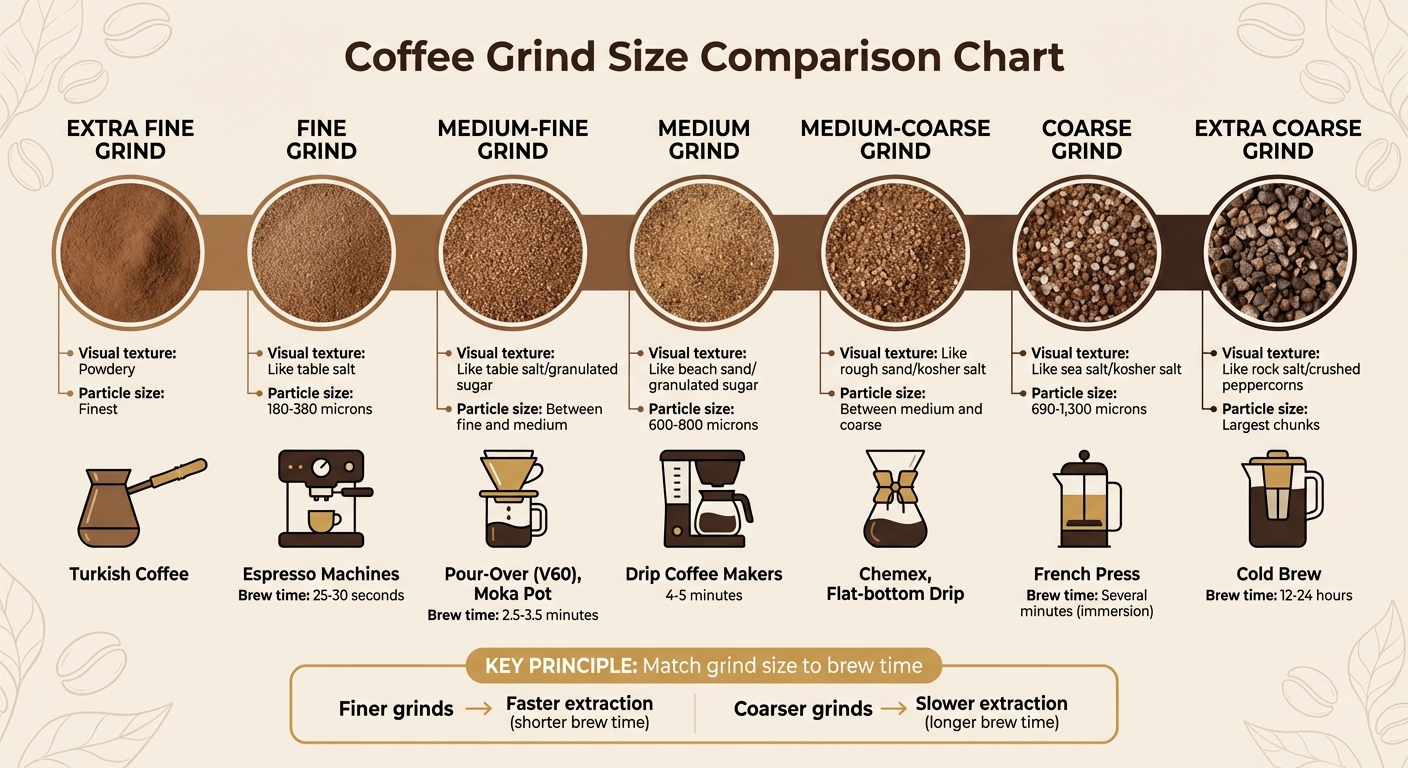
Coffee Grind Size Chart by Brewing Method
The Grind Guide: Best Coffee Grind Sizes for Every Brewing Method
Coffee Grind Sizes Explained
Coffee grind sizes range from chunky pebbles to powder-fine dust, and each has a specific role in brewing. To make it easier to visualize, think of them as resembling common kitchen items.
Extra coarse grinds are similar in size to rock salt or crushed peppercorns. These large, chunky particles are perfect for cold brew, where water slowly extracts flavors over 12–24 hours. Coarse grinds, which look like sea salt or kosher salt, work well for French press brewing, allowing for a rich, full-bodied cup. Medium-coarse grinds resemble rough sand or kosher salt and are ideal for Chemex brewers or flat-bottom drip machines. Medium grinds, with a texture like beach sand, suit most automatic drip coffee makers.
As the grind gets finer, medium-fine particles take on the texture of table salt or granulated sugar. This size is commonly used in pour-over methods like the V60 and even in Moka pots. Fine grinds, which feel like refined table salt or flour, are essential for espresso machines. They provide the necessary resistance for the 25–30 second extraction process at 9 bars of pressure. Finally, extra fine grinds, with a powdery consistency similar to flour or powdered sugar, are specifically used for brewing Turkish coffee.
"Grinding is the bridge between your beans and your brew." – 1Zpresso
Grind size plays a critical role in how coffee flavors are extracted. Finer grinds expose more surface area, leading to faster extraction and typically resulting in stronger, more robust flavors. On the other hand, coarser grinds extract more slowly, creating a lighter, cleaner-tasting cup.
Matching Grind Size to Your Coffee Maker
Getting the grind size right is crucial for brewing a great cup of coffee. The grind affects how water interacts with the coffee grounds, impacting flavor and extraction. If the grind is too fine, the coffee can taste bitter; too coarse, and it may end up weak or sour. Here’s how to match your grind size to your brewing method.
Drip Coffee Makers: Medium Grind
Drip coffee makers work best with a medium grind, similar in texture to granulated sugar. This grind size ensures water flows evenly during the 4–5 minute brewing cycle, creating a balanced cup. The ideal particle size falls between 600–800 microns, but you might need slight adjustments depending on your machine and filter type.
While most pre-ground coffee is already set to a medium grind, grinding your beans fresh just before brewing can elevate the flavor. If you’re using a Keurig or another single-serve system, stick to the same 600–800 micron range for optimal results.
Taste can guide your adjustments:
- If the coffee tastes sour or acidic, try a finer grind to improve extraction.
- If it’s bitter or flat, go coarser to reduce over-extraction.
Filter type also plays a role. Thick paper or metal filters generally work better with a medium-to-coarse grind, while thin paper filters may benefit from a medium-to-fine grind to control water flow.
Espresso Machines: Fine Grind
Espresso machines demand precision, requiring a fine grind similar to table salt. This fine texture helps form a compact "puck", slowing water flow during the 25–30 second brewing process. The recommended grind size ranges from 180–380 microns, allowing the machine to extract the rich oils and flavors unique to espresso.
"Grind size uniformity (consistency) is by far more important than the grind size itself - whether brewing for espresso or pour over." – Scott Rao and Chahan Yeretzian, Coffee Professionals
Consistency is critical. Uneven grinds can cause channeling, where water flows unevenly, leading to a bitter or unbalanced shot. A burr grinder is your best tool for achieving uniformity. Adjust the grind in small increments - just one or two clicks at a time:
- If your espresso tastes sour, go finer.
- If it’s bitter or the water struggles to flow, try a coarser grind.
Always grind your beans right before brewing to preserve the coffee’s aromatic qualities.
French Press: Coarse Grind
The French press relies on immersion brewing, which works best with a coarse grind resembling sea or kosher salt. The ideal grind size falls between 690–1,300 microns, allowing the coffee to steep for several minutes without becoming over-extracted.
The metal mesh filter in a French press has larger openings, so a coarse grind helps keep fine particles out of your cup. This grind also makes plunging easier and prevents clogs.
"The openings of the metal mesh on the plunger are too large to block fine particles. However, even with a coarse grid, a small amount of particles are expected in the final brew. This is what gives French press coffee its popular taste profile - a rich, cloudy body and texture." – Honest Coffee Guide
Avoid using pre-ground coffee meant for drip machines, as its medium grind can leave your brew bitter and gritty. If the plunger feels hard to press, the grind is likely too fine. A burr grinder ensures consistent particle size. Adjust based on taste:
- If the coffee is bitter or dull, try a coarser grind.
- If it’s sour, go a bit finer.
Before adding water, give the grounds a gentle shake to level them for even saturation.
Pour-Over Setups: Medium-Fine Grind
Pour-over methods, like the V60, thrive with a medium-fine grind that feels like table salt or granulated sugar. The grind size should match your dripper’s design and flow rate. For example:
- Cone-shaped drippers with a single hole (like the V60) often need a finer grind to slow the water flow.
- Flat-bottom drippers with multiple holes may perform better with a slightly coarser grind.
Brew time is another factor. If the water drains too quickly (under 2 minutes) and the coffee tastes weak, go finer. If it drains too slowly (over 4 minutes) and the brew tastes bitter, try a coarser grind. For most pour-over methods, aim for a total brew time of 2.5–3.5 minutes.
Adjustments may also depend on batch size. Larger batches might need a coarser grind to avoid over-extraction, while smaller ones could benefit from a finer grind to ensure enough contact time. Whatever your setup, small tweaks can make a big difference in your cup.
sbb-itb-ed7145d
Fwing Coffee Grinder Settings Guide

Now that you know how grind size affects flavor, let’s explore how Fwing Coffee grinders make it easier to nail the perfect setting. By aligning grind size with your brewing method, Fwing grinders take the guesswork out of fine-tuning your coffee extraction.
Fwing grinders are designed to provide consistent results, allowing you to visually adjust your grind for optimal brewing.
Use visual texture as your guide.
A simple way to assess your grind size is by comparing it to everyday items. For instance, fine grinds should look like table salt or flour, medium grinds resemble granulated sugar or sand, and coarse grinds are similar to sea salt or cracked peppercorns. This method eliminates the need for special tools, making adjustments quick and straightforward.
Consistency is key, not absolute precision.
Burr grinders, like those in Fwing models, ensure uniform particle sizes, which is critical for even extraction. In contrast, blade grinders often produce an uneven mix of fine powder and larger chunks, leading to inconsistent brewing and off flavors. With Fwing’s burr mechanisms, you’ll enjoy more control over your coffee’s flavor profile.
Adjusting Fwing settings for your brewing method.
To get the best results, match your Fwing grinder’s settings to your brewing method: go finer for espresso or pour-over, and coarser for French press. This helps you aim for the ideal 18–22% extraction range we discussed earlier.
Start with the recommended grind setting for your coffee maker, then tweak it based on taste. If your coffee tastes sour or weak, try a finer grind. If it’s bitter or overly strong, go coarser.
Conclusion
The information above provides a clear roadmap for finding the right grind size for any brewing method. The key takeaway? Match your grind size to your brewing time. Fine grinds are ideal for quick extractions like espresso, medium grinds suit drip coffee makers and pour-over methods, while coarse grinds shine in French presses. When you get the grind just right, you’ll enjoy a perfectly balanced flavor every time.
Fwing Coffee grinders give you the flexibility to adjust your grind for any brewing style. As Juliet Han wisely says: "The world of coffee is an enchanting place for those who are curious and gutsy. You're the boss in deciding what you enjoy". Start with the suggested grind size and tweak it to suit your personal taste.
FAQs
How does the grind size impact the taste of my coffee?
Grind size is a crucial factor in shaping the flavor of your coffee because it directly affects how quickly flavors are extracted during brewing. Finer grinds allow for faster extraction, which can intensify the flavor but may also lead to bitterness if overdone. In contrast, coarser grinds extract more slowly, which can result in a weaker or even sour taste if the brewing time isn’t long enough.
The secret to a great cup of coffee lies in pairing the grind size with the right brewing method. For instance, a fine grind works best with espresso machines, a medium grind is ideal for drip coffee makers, and a coarse grind suits French presses perfectly. By aligning your grind size with your brewing style, you can unlock the full potential of your coffee every time.
Why does my coffee taste bitter, and how can grind size help fix it?
If your coffee has a bitter edge, it's probably over-extracted. This happens when the water draws out too much from the coffee grounds. An easy fix? Switch to a coarser grind. Coarser grounds slow the extraction process, helping to tone down the bitterness and create a more balanced flavor.
Play around with slight changes to the grind size until you hit the sweet spot for both your coffee maker and your taste buds. Brewing the perfect cup is all about striking that ideal balance!
Can I use a blade grinder to get a consistent coffee grind?
When it comes to grinding coffee beans, blade grinders often fall short. They chop the beans unevenly, resulting in an inconsistent grind size that can throw off your brew. If you're aiming for better precision and consistency, a burr grinder is the way to go. Unlike blade grinders, burr grinders crush the beans evenly, allowing you to match the grind size to your brewing method and extract the best possible flavor from your coffee.