

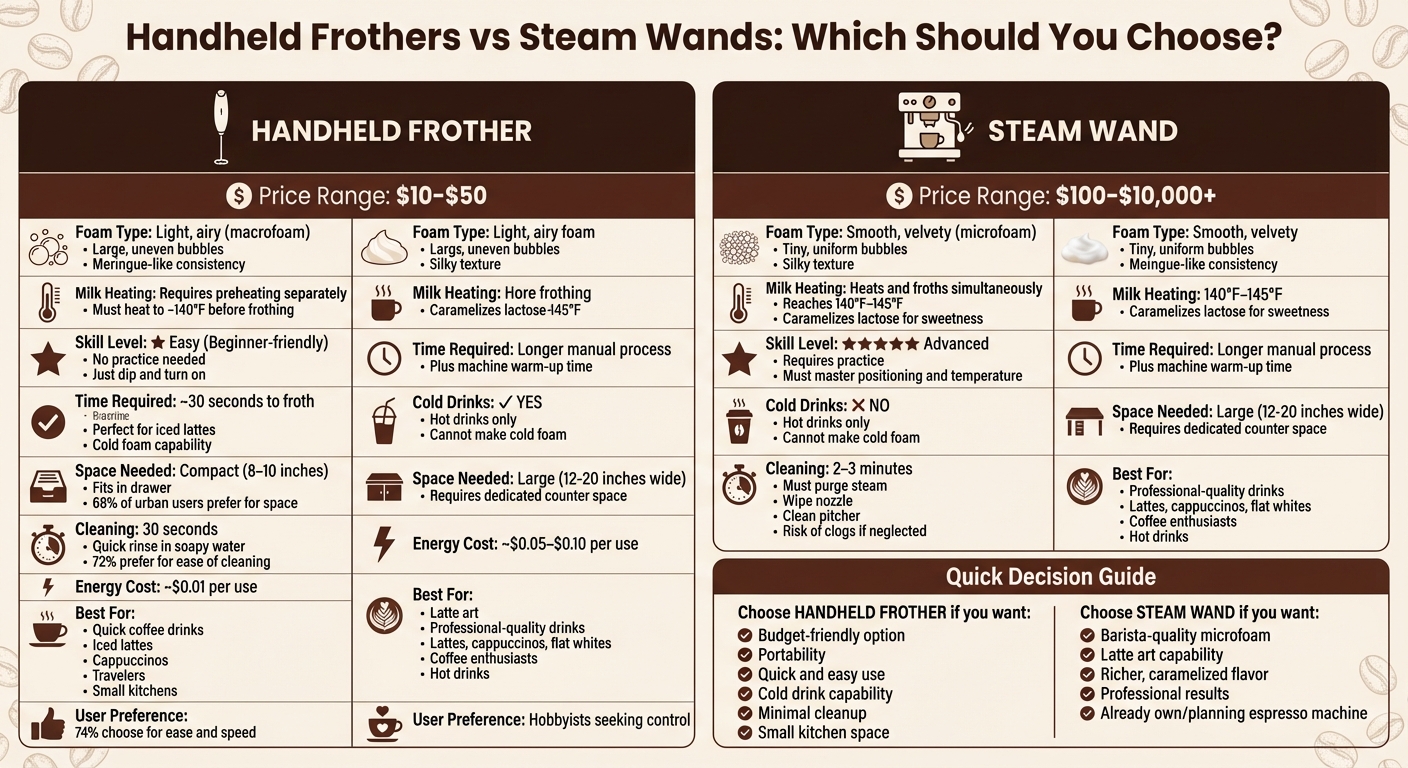
When it comes to frothing milk, handheld frothers and steam wands each have their strengths. Handheld frothers are affordable, portable, and easy to use, making them ideal for beginners or casual coffee drinkers. They create light, airy foam but don’t heat milk, so you’ll need to warm it separately. Steam wands, on the other hand, are built into espresso machines and produce silky, smooth microfoam perfect for latte art. They heat and froth milk simultaneously but require more skill, practice, and a higher budget.
Quick Overview:
- Handheld Frothers: Cost $10–$50, compact, beginner-friendly, create airy foam, require preheated milk, work for hot and cold drinks.
- Steam Wands: Part of espresso machines ($100–$10,000+), produce microfoam, perfect for hot drinks and latte art, require practice, take up more space.
Quick Comparison:
| Feature | Handheld Frother | Steam Wand |
|---|---|---|
| Price | $10–$50 | $100–$10,000+ |
| Foam Type | Light, airy (macrofoam) | Smooth, velvety (microfoam) |
| Milk Heating | Requires preheating | Heats and froths together |
| Skill Level | Easy for beginners | Requires practice |
| Use for Cold Drinks | Yes | No |
| Space Needed | Compact, drawer-friendly | Requires counter space |
| Cleaning | Quick rinse | More effort, purging needed |
Choose a handheld frother for simplicity and portability or a steam wand for professional-quality results.
Handheld Frothers vs Steam Wands: Complete Comparison Guide
Milk Frother vs Steam Wand || Which Makes Better Lattes at Home?
What Are Handheld Frothers?
A handheld frother is a compact device, either battery-operated or electric, with a motor-powered whisk designed to quickly aerate milk without heating it [4]. To use one, you simply immerse the whisk into a container filled about one-third with milk. In roughly 30 seconds, the milk can double in volume [10]. These frothers are lightweight, easy to store, and perfect for small kitchens or when you're on the go.
Main Features of Handheld Frothers
Handheld frothers are one of the most budget-friendly options available, with many models priced affordably in the low tens of dollars. Their compact and lightweight design makes them easy to slip into a drawer when not in use.
The foam they produce, often called "macrofoam", is made up of light, airy bubbles. While this type of foam is great for cappuccinos, it typically doesn’t achieve the dense, silky "microfoam" needed for professional latte art [2] [11]. Beyond frothing milk for coffee, these tools are surprisingly versatile. They can whip cream, beat eggs, mix matcha, or even emulsify salad dressings. Cleaning is a breeze - just run the whisk in warm, soapy water for a few seconds, then rinse [9].
When to Use Handheld Frothers
Handheld frothers are perfect for quick and simple coffee drinks like iced lattes, cappuccinos, or any recipe where professional-grade foam isn’t necessary [4]. They’re especially handy for making cold foam, though frothing cold milk may take a bit longer to achieve the desired texture. For best results, always start with cold milk, as pre-heated milk can destabilize the foam by breaking down fats and proteins [10]. Using a deep, heat-resistant container can also help minimize splashing from the high-speed whisk [9].
If you're after an affordable, portable, and easy-to-use tool to elevate your coffee game without the complexity of a steam wand, a handheld frother is a fantastic option. Up next, we’ll explore steam wands and how they offer a different way to create café-quality foam.
What Are Steam Wands?
A steam wand is a metal nozzle or arm attached to an espresso machine that releases high-pressure steam to heat and texture milk simultaneously [12][2]. Unlike handheld frothers, which only aerate milk, steam wands do two jobs at once - they warm your milk to the ideal temperature range of 140°F to 145°F and create what baristas call "microfoam" [3][4]. This microfoam consists of tiny, nearly invisible bubbles that give steamed milk a glossy, velvety texture - the hallmark of professional café drinks. Here’s how it works.
The process starts with stretching the milk by introducing air, followed by churning to refine the bubbles into a smooth texture [3][2]. The steam also breaks down milk fats and melts lactose (milk sugars), naturally sweetening the milk and enhancing its creamy flavor [3][5].
Main Features of Steam Wands
Steam wands are built into espresso machines and aren’t sold as separate tools. Espresso machines with steam wands can range in price from about $100 for beginner models to over $10,000 for commercial-grade setups [2]. There are two primary types of steam wands: standard pin-hole wands, which have small holes at the tip for maximum control (great for latte art), and Panarello wands, which feature air-intake holes to help beginners create thicker foam with less effort [12].
The standout feature of steam wands is the microfoam they produce - tiny, velvety bubbles that are stable enough for intricate latte art. This texture is very different from the light, airy "macrofoam" made by handheld frothers [2][4]. Steam wands also give you precise control over the milk’s temperature and texture. However, they do require practice to master. You’ll need to learn proper positioning, listen for the distinctive paper-tearing sound, and develop a feel for when the milk reaches the perfect temperature [3].
To keep your steam wand in good condition, always purge it before and after use to clear out condensation and milk residue, and wipe it down with a damp cloth [3][2].
When to Use Steam Wands
If you’re aiming for café-quality drinks like lattes, cappuccinos, or flat whites, a steam wand is your best friend. It’s essential for creating the smooth, pourable microfoam needed for latte art [2][4]. However, steam wands are designed for hot drinks only - they can’t make cold foam because they rely on heat and pressurized steam to work [2][1].
If you already own an espresso machine with a steam wand or are considering investing in one, the benefits are worth it. You’ll enjoy richer flavors and textures that rival those from a professional barista. Just keep in mind that mastering the technique takes time, patience, and plenty of practice.
How Functionality and Foam Quality Compare
Handheld frothers and steam wands achieve their results in very different ways. Handheld frothers mechanically whip air into milk without heating it [4], while steam wands use high-pressure steam to both heat and aerate the milk simultaneously [3]. Let’s break down how these differences affect foam texture and milk heating, which are key to your coffee’s overall quality.
Foam Texture and Thickness
Handheld frothers create what’s known as "macrofoam" - a light, airy foam with larger, uneven bubbles that resemble a meringue-like consistency floating on top of your coffee [1][8]. On the other hand, steam wands produce "microfoam", which is silky and velvety, with extremely small, uniform bubbles that blend smoothly into the milk [1].
The difference lies in the technique: handheld frothers whip air into the milk, resulting in a fluffy, airy texture, while steam wands inject steam directly, creating a dense and velvety microfoam [2].
As Breville explains:
Steamers achieve a smoother, finer milk froth with very small, uniform bubbles perfect for latte art [1].
Microfoam is essential for making professional-level lattes and flat whites because its smooth texture allows for intricate latte art. In contrast, the macrofoam from handheld frothers is better suited for cappuccinos, where a thick, dry foam layer is preferred. However, macrofoam is generally too unstable for detailed latte art [2][8]. These differences in foam texture are closely tied to how each tool handles milk heating, which we’ll explore next.
Milk Heating Ability
Steam wands excel at heating milk to the ideal range of 140°F–145°F, a process that caramelizes lactose, enhancing the milk's sweetness and richness [3][2]. They operate within a temperature range of 131°F to 143°F, which helps break down milk fats and coagulate proteins, creating the signature microfoam texture [2].
With handheld frothers, the milk must be preheated - ideally to around 140°F - to replicate the sweetness and texture of steamed milk [2]. This adds an extra step, requiring careful temperature control. Milk that’s too cool won’t deliver the desired taste or foam quality, while overheating it beyond 145°F can ruin the foam and introduce a bitter, sulfurous flavor [3].
Each method has its strengths, but steam wands offer the advantage of combining heating and frothing in one seamless step, making them the go-to choice for achieving barista-quality results. Handheld frothers, while convenient, require a bit more effort to match those results.
sbb-itb-ed7145d
Ease of Use and Skill Requirements
Which Is Easier for Beginners
Handheld frothers are incredibly straightforward to use - just dip the whisk into your milk and turn it on. No special skills or techniques are needed. As one expert succinctly puts it:
Just submerge the frother in milk, turn it on, and watch it work its magic [2].
Steam wands, on the other hand, require a bit more finesse. The process involves two key steps: first, you "stretch" the milk by positioning the wand tip just below the surface; next, you create a vortex to achieve that silky, velvety texture - all while keeping a close eye on the temperature, which should stay between 140°F and 145°F [15][3]. Laura Honey, an eCommerce Editor and Qualified Barista, explains:
Practice makes perfect when you're learning how to steam milk. While it might not be an instant success, if you team some expert barista tips with a few weeks of practice, you'll be making silky, velvety milk... in no time [15].
Handheld frothers eliminate the need to manage temperature during the frothing process since the milk is pre-warmed. This simplicity makes them a hassle-free option, especially for beginners.
Time and Effort Needed
Ease of use isn't just about learning - it also affects how much time and effort you’ll spend daily. Handheld frothers are quick and efficient, taking roughly 30 seconds to froth milk. Cleanup is equally simple, requiring just 2–3 minutes for a quick rinse or scrub [2][16].
Steam wands, however, demand more attention. You’ll need to adjust the wand during use and clean it promptly afterward. This involves wiping it down with a damp cloth and purging to remove any milk residue. Skipping this step can lead to clogs that may require special tools to fix [15].
Here’s a quick comparison of the two options:
| Feature | Handheld Frother | Steam Wand |
|---|---|---|
| Learning Curve | Very low; beginner-friendly [4] | High; requires practice [15] |
| Active Time | ~30 seconds [2] | Longer, manual process [14] |
| Cleaning | Quick scrub/rinse [16] | Requires purging and scrubbing [15] |
| Skill Level | Minimal [4] | Advanced [15] |
Next, we'll dive into costs, space considerations, and cleanup to help you decide which tool fits your needs best.
Cost, Space, and Cleanup Comparison
Side-by-Side Comparison Table
When it comes to cost and convenience, the differences between handheld frothers and steam wands are quite clear. Handheld frothers typically cost between $10 and $50, making them an affordable option for almost any budget [6][2]. On the other hand, steam wands are integrated into espresso machines, which can significantly increase their price. Entry-level espresso machines with steam wands start at around $100, while higher-end models can range anywhere from $500 to over $10,000 [6][2].** For perspective, the cost of a handheld frother is often less than what you'd spend on a week's worth of lattes from your local coffee shop [17].
In terms of space, handheld frothers are small and lightweight, easily stored in a kitchen drawer, making them an excellent choice for those with limited counter space [6]. Steam wands, however, are part of larger espresso machines that require dedicated counter space, often taking up 12 to 20 inches of width [6]. This is why about 68% of home baristas in urban areas prefer handheld frothers due to their compact design [6].
Cleaning is another area where handheld frothers shine. They can be cleaned in just 30 seconds by spinning the whisk in warm, soapy water [6][9]. Steam wands, however, require a bit more effort - 2 to 3 minutes to purge steam, wipe the nozzle, and clean the frothing pitcher [6][2]. Neglecting this routine can lead to stubborn clogs that demand specialized cleaning tools [2]. Unsurprisingly, 72% of home users favor handheld frothers for their ease of cleaning [6].
Here's a side-by-side breakdown of the key differences:
| Feature | Handheld Frother | Steam Wand (Integrated) |
|---|---|---|
| Price Range | $10–$50 [6][2] | $100–$10,000+ [6][2] |
| Space Needs | Compact; fits in drawer (~8–10 inches) [6] | Large; requires counter space (~12–20 inches wide) [6] |
| Cleaning Effort | Simple 30-second rinse [6] | 2–3 minutes; purging, wiping, deep cleaning [6][2] |
| Energy Cost | ~$0.01 per use [6] | ~$0.05–$0.10 per use [6] |
| Maintenance | Battery replacement only [2] | Purging, nozzle disassembly, descaling [3][13] |
For those with limited space or a tight budget, handheld frothers are a clear winner. They're perfect for students, travelers, or anyone looking for a simple, hassle-free way to froth milk. Steam wands, however, are better suited for serious coffee enthusiasts who want professional-level control and are willing to invest in a full espresso setup.
Performance with Hot and Cold Drinks
Let’s dive into how these tools handle both hot and cold beverages, building on their functionality and foam quality.
Making Hot Drinks
Steam wands are designed specifically for hot drinks like lattes, cappuccinos, and flat whites. They use pressurized steam to heat and aerate milk, bringing it to the ideal temperature range of 140°F to 145°F [3]. This process doesn’t just warm the milk - it creates microfoam, which consists of tiny, velvety bubbles that blend seamlessly into the milk for a smooth texture [4][7]. The heat also melts lactose and breaks down fats, enhancing the milk's natural sweetness and adding depth to its flavor [2].
"Milk frothed with a steam wand can have a slightly richer and more complex flavor due to the caramelization of some milk sugars during heating." - Tim Lee Hopfinger, Founder, TimsCoffee.com [2]
On the other hand, handheld frothers don’t heat the milk - they simply whip it into foam. This means you’ll need to warm the milk separately [4]. The result is macrofoam, which consists of larger, airier bubbles that sit as a distinct layer on top of the liquid [2]. While this foam works well for a quick cappuccino if you like a thick, stiff topping, it’s not ideal for creating latte art [2][4]. To avoid scalding or bitterness, keep milk temperatures below 160°F [7][3]. While steam wands shine for hot drinks, handheld frothers have their own strengths when it comes to cold beverages.
Making Cold Drinks
When it comes to cold drinks like iced lattes or cold foam toppings, handheld frothers take the lead. They can froth milk without adding heat, making them perfect for working with refrigerated milk [4]. Steam wands, on the other hand, heat and froth simultaneously, bringing milk to a temperature range of 131°F to 143°F, which isn’t suitable for cold drinks [2].
"If you solely enjoy iced coffee with cold foam, a milk frother may be all you need." - Breville [1]
For cold drinks, you may need to froth the milk longer than the manufacturer’s guidelines to achieve a stable and lasting foam [9]. America’s Test Kitchen even named the Zulay Kitchen Milk Boss their "Handheld Winner" for producing the richest cold foam among similar models [9]. This makes handheld frothers a great choice for iced coffee lovers or anyone seeking a versatile tool for both hot and cold beverages, especially without investing in a full espresso machine setup.
Choosing the Right Tool for Your Needs
When deciding between a handheld frother and a steam wand, it all comes down to what you value most in your coffee routine. A steam wand is perfect if you're aiming for barista-level microfoam for latte art and are willing to put in the practice. On the other hand, if you prefer quick, hassle-free frothing, a handheld frother offers convenience and portability at various price points.
As Tim Lee Hopfinger, founder of TimsCoffee.com, explains:
"Milk frothers are better for an average coffee drinker because they don't require skill to use... Steam wands are better for hobbyists since they offer more control." [2]
Space and time play a big role too. Handheld frothers are compact and quick, making them a favorite for busy mornings. In fact, 74% of home baristas opt for them for their ease and speed [6]. Steam wands, on the other hand, require dedicated counter space, take time to warm up, and consume more energy. For those living in small spaces or who travel frequently, 68% prefer handheld frothers for their portability [6].
Your drink preferences matter. If you're a fan of iced lattes with cold foam, a handheld frother is your go-to, as steam wands only work with hot milk [2][1]. For creamy, hot lattes and cappuccinos, steam wands excel by caramelizing milk sugars for a richer flavor. Meanwhile, handheld frothers create a lighter, airier foam that floats on top of your drink [2][4]. By considering your lifestyle and coffee habits, you can pick the tool that fits seamlessly into your daily routine.
FAQs
What makes a steam wand better than a handheld frother?
A steam wand brings a whole new level of sophistication to milk frothing. It produces silky, dense microfoam that’s ideal for latte art and creates a texture that feels like it came straight from a café. Plus, it gives you precise control over the milk’s temperature and consistency, which is key for making specialty drinks like lattes and cappuccinos just right.
If you’re a coffee lover aiming to take your home brewing game up a notch, a steam wand can help you achieve those professional, café-quality results.
Can you use a handheld frother to make latte art?
Yes, a handheld frother can be used to create foam for latte art, though it might take some practice to get the texture just right. These frothers often produce foam with larger bubbles, which isn't as silky as the microfoam made with a steam wand. To improve the foam's quality, heat your milk to about 140–150°F and use a gentle swirling motion while frothing to create a more consistent texture. With a bit of patience and the right technique, you can achieve some impressive latte art!
What’s the best tool for making cold foam for iced coffee?
A handheld milk frother is a fantastic tool for creating cold foam for iced coffee. It's easy to use, works effortlessly with cold milk, and doesn't need any complicated setup. Its compact, portable design makes it convenient for frothing both at home and wherever you might be.
For those who love creamy iced coffee, this little gadget can whip up smooth, velvety foam that takes your drink to the next level.