

Coffee loses its flavor quickly when exposed to oxygen, light, heat, and moisture. Proper storage can help retain its aroma and taste for longer. Here’s what you need to know:
- Whole beans stay flavorful for up to 6 months, while ground coffee lasts just 7–14 days without proper storage.
- Airtight containers with vacuum seals are best to limit oxygen exposure.
- Opaque materials like stainless steel or ceramic block harmful light.
- Avoid storing coffee in the fridge or freezer for daily use - moisture and odors can ruin it.
- Keep coffee in a cool, dark place (50°F–70°F) away from heat sources.
Best materials for containers:
- Stainless steel: Durable, non-porous, blocks light.
- Glass: Lets you see contents but needs dark storage.
- Plastic: Lightweight but can absorb odors.
- Ceramic: Blocks light and prevents flavor transfer.
Invest in a container that fits your coffee quantity to minimize air exposure. Vacuum-sealed options, like the Fellow Atmos or Airscape, extend coffee’s freshness by weeks. Whether you’re a casual drinker or a coffee enthusiast, the right storage preserves quality and ensures every cup tastes its best.
Why Coffee Storage Matters
How Coffee Loses Freshness
Coffee's vibrant flavors and aromas are surprisingly fragile. Oxidation, the main culprit, breaks down aromatic oils and volatile compounds, leaving your coffee tasting flat and lifeless over time [1][10]. Pam Viguera, Manager at Fellow Coffee, puts it simply:
"One thing that people [don't] know is how oxidation really is the ruiner of coffee." [2]
Light exposure is another freshness killer. UV rays from sunlight - or even bright artificial lighting - trigger photooxidation, which damages the delicate acids and oils responsible for coffee's unique taste [1][10]. Opaque containers are your best defense against this.
Moisture is equally problematic. Coffee beans act like sponges, soaking up water and surrounding odors, which dulls their flavor [9][1]. Michael Phillips, Director of Training at Blue Bottle Coffee, explains:
"Coffee is like a sponge: Once it's been processed, it's dry, coarse, and absorbent... in the freezer, it will start to absorb the flavors floating around in there." [8]
Heat speeds up the staleness process. Storing beans near heat sources like ovens or sunny windows can quickly ruin their freshness. The ideal storage temperature ranges between 50°F and 70°F [3]. For even better results, consider containers that regulate temperature. Ground coffee, due to its larger exposed surface area, loses flavor and aroma much faster than whole beans [10][2].
Improper storage only amplifies these issues, making it harder to enjoy coffee at its peak.
Common Storage Mistakes
Many common habits unintentionally accelerate coffee's decline. For example, storing beans in the refrigerator or freezer for daily use is a big no-no. Each time you take them out, condensation forms, introducing moisture that wreaks havoc on the beans [9][10]. Steven Sutton, Founder of Devoción, emphasizes:
"The key is to store your beans in a dry, dark place in a vacuum-sealed container to reduce the risk and speed of oxidation. The biggest mistake is putting beans in the freezer or fridge." [4]
Using containers without proper seals is another frequent misstep. Loose-fitting lids or retail coffee bags often allow air to creep in, enabling oxidation to continue [1]. Even worse, oversized containers create excess headspace, trapping oxygen with the beans and speeding up staleness [1]. To avoid this, match your container size to your coffee purchase - 0.7L to 1L canisters work well for a standard 250g bag.
Finally, don’t forget to clean your storage containers regularly. Residual coffee oils can turn rancid over time, contaminating your fresh beans [1][3]. A little extra care in storage can make all the difference in preserving that perfect cup.
The Best Coffee Storage Canister
Coffee Storage Container Materials
Choosing the right material for a coffee storage container is essential to combat the four main threats to freshness: oxygen, light, heat, and moisture. Each material has its strengths and drawbacks, affecting durability, light protection, and flavor preservation. Let’s break down the options.
Stainless steel is often considered the gold standard for coffee storage. It’s non-porous, meaning it won’t absorb old coffee oils that could spoil and ruin fresh beans [1]. Howard Bryman, a coffee journalist, explains:
"Steel canisters strike an ideal balance between durability, ease of cleaning, the rigidity needed for a tight seal, and the blocking of light" [6].
Stainless steel containers completely block UV light and are built to last. However, they do conduct heat, so it’s best to store them away from heat sources like stoves or sunny windowsills [11]. Prices for high-quality stainless steel models range from $25 to $49.
Stainless Steel Containers
These containers excel in protecting coffee from light and oxidation, ensuring better flavor retention. Their non-absorbent surface prevents the buildup of odors and oils, making them easy to maintain. While they can conduct heat, their sturdy build and tight seals make them a reliable choice for long-term use. Options like the Fellow Atmos (around $40) and Coffee Gator (around $25) showcase the variety available, with some premium models featuring vacuum-sealing technology for enhanced freshness [6].
Glass Containers
Glass containers are ideal for those who want to monitor their coffee bean levels. They are non-reactive, which means they won’t alter the flavor of your coffee [11]. However, they provide minimal UV protection unless heavily tinted, so they’re better suited for storage in dark places like pantries rather than on countertops [1]. Glass is also more fragile and less effective at insulating against temperature changes. A popular choice, the EVAK Storage Container, is priced at about $22–$24 [13].
Plastic Containers
Plastic containers are lightweight, affordable, and portable, making them a convenient option for short-term storage or travel. For instance, the Yamazaki Home vacuum-sealed container costs around $28 [6]. However, plastic is porous, which means it can absorb odors and oils over time, potentially affecting the taste of future batches. As Seven Sisters Coffee Co. notes:
"Plastic can sometimes absorb odours and oils over time, which can taint future batches of beans" [1].
If you choose plastic, look for food-grade, BPA-free options, and avoid using them for long-term storage.
Ceramic Containers
Ceramic containers are known for their ability to block light and their timeless aesthetic appeal [1]. They are a great option for maintaining the authentic taste of your coffee without any flavor transfer [1]. However, ceramic is heavier and more fragile than stainless steel, making it better for stationary storage in a pantry rather than frequent handling. Leo Yuffa, owner of Dazbog Coffee, advises:
"Right after opening the bag, the coffee should be poured into a glass, ceramic, or metal container. The container should be kept out of light and heat" [4].
What to Look for in Coffee Storage Containers
Once you've chosen the right material for your coffee container, the next step is to focus on features that help preserve the freshness and flavor of your beans. A well-designed container can keep your coffee tasting great for weeks.
Airtight Seals
An airtight seal is essential for keeping oxygen out, as oxygen exposure can strip coffee beans of their aromatic oils. Look for containers with silicone or rubber gaskets that create a tight seal between the lid and the body.
To test the seal, you can submerge the closed container in water - if no bubbles escape, the seal is effective. Keep in mind that ziplock bags often fall short in maintaining a proper seal. By comparison, whole beans stored in a high-quality airtight container can retain their flavor for 3–4 weeks, while beans in an opened bag may only last about a week.
However, even airtight containers have some air trapped inside (headspace), which still contains oxygen. While these seals prevent new oxygen from entering, vacuum sealing takes it a step further by removing the trapped air, offering longer-lasting freshness.
Vacuum Sealing
Vacuum sealing goes beyond airtight storage by actively removing the air inside the container, which helps extend the freshness of your coffee. This can be achieved through manual twist mechanisms, plungers, or electric pumps. Some containers even include built-in pumps or plungers to make this process easier.
With vacuum-sealed containers, you can extend the freshness of your beans to 5–6 weeks, compared to the 3–4 weeks offered by standard airtight options. If you're spending extra on premium coffee, investing in a vacuum-sealed container is a smart choice.
It's worth noting that freshly roasted beans release CO₂ for several days. A one-way degassing valve can help by allowing the gas to escape while keeping oxygen out. CJ Speelman, a coffee roasting expert, explains:
"These valves allow gas to exit the bag while ensuring that no oxygen enters. Storage canisters often feature one-way valves as well."
UV Protection
Exposure to light speeds up the oxidation process, even when oxygen is limited, leading to quicker degradation of the coffee's oils. Opaque materials like stainless steel or ceramic block all UV rays, making them ideal for protecting your beans. On the other hand, clear glass or plastic containers offer little protection unless stored in a dark place.
Heather Calatrello, a seasoned coffee roaster, emphasizes:
"Keep it away from air, moisture, heat, and light. When coffee beans are exposed to these elements, they can quickly degrade in quality."
Similarly, Leo Yuffa, an experienced industry professional, advises:
"The container should be kept out of light and heat. I recommend storing coffee in a closed kitchen cabinet away from the sink, windows, or stoves to protect it from moisture, direct light, and temperature changes."
If you prefer to see how much coffee you have left, consider UV-blocking tinted plastic containers. These offer some visibility while still providing protection. However, for the best results, opaque containers stored in a cool, dark place - like a cabinet - are your safest bet.
Container Sizes and Capacities
Selecting the right container size is key to keeping your coffee fresh. The goal is to minimize headspace, which can trap oxygen and degrade the aromatic oils in your beans.
Containers for Daily Use
For everyday use, a 1.2-liter canister is perfect for holding a standard one-pound (16 oz) bag of whole beans. This matches the size of most retail coffee bags and ensures minimal air exposure. If your go-to purchase is smaller bags, like 10–12 oz, opt for a container in the 8–12 oz range to reduce unnecessary space.
Afton Cyrus from Serious Eats emphasizes this point:
"Get a canister that's just big enough for it (extra air will just cause the beans to degrade faster). A 1.2‑liter canister that holds one pound of coffee beans will likely work well for most people." [12]
For even greater precision, single-dose tubes are an excellent option. These tubes hold 22–24 grams - enough for brewing one cup - while limiting repeated air exposure. Andrew Pernicano of Weber Workshops explains:
"If an average coffee drinker consumes a 10‑ounce bag every week or two, one dozen Weber Workshop tubes can accommodate it all. Each tube will hold approximately 22–24 grams of coffee." [2]
Bulk Storage Containers
When it comes to bulk storage, the strategy shifts. While buying in bulk can be economical, exposing all your coffee to air each time you open the container can lead to faster degradation. The solution? Divide your bulk purchase into smaller airtight containers. Use one container, such as a 1.2-liter canister, for daily use, and keep the rest sealed in a cool, dark place [12].
For larger quantities, consider containers like the Airscape Kilo, which holds up to 2.2 lbs of beans. Models with displacement lids are particularly effective, as they push out excess air by pressing down to the bean surface [6]. If your coffee stash exceeds what you can consume in 3–4 weeks, freezing smaller portions in airtight containers is a smart way to maintain freshness over time [5].
sbb-itb-ed7145d
Coffee Storage Container Comparison
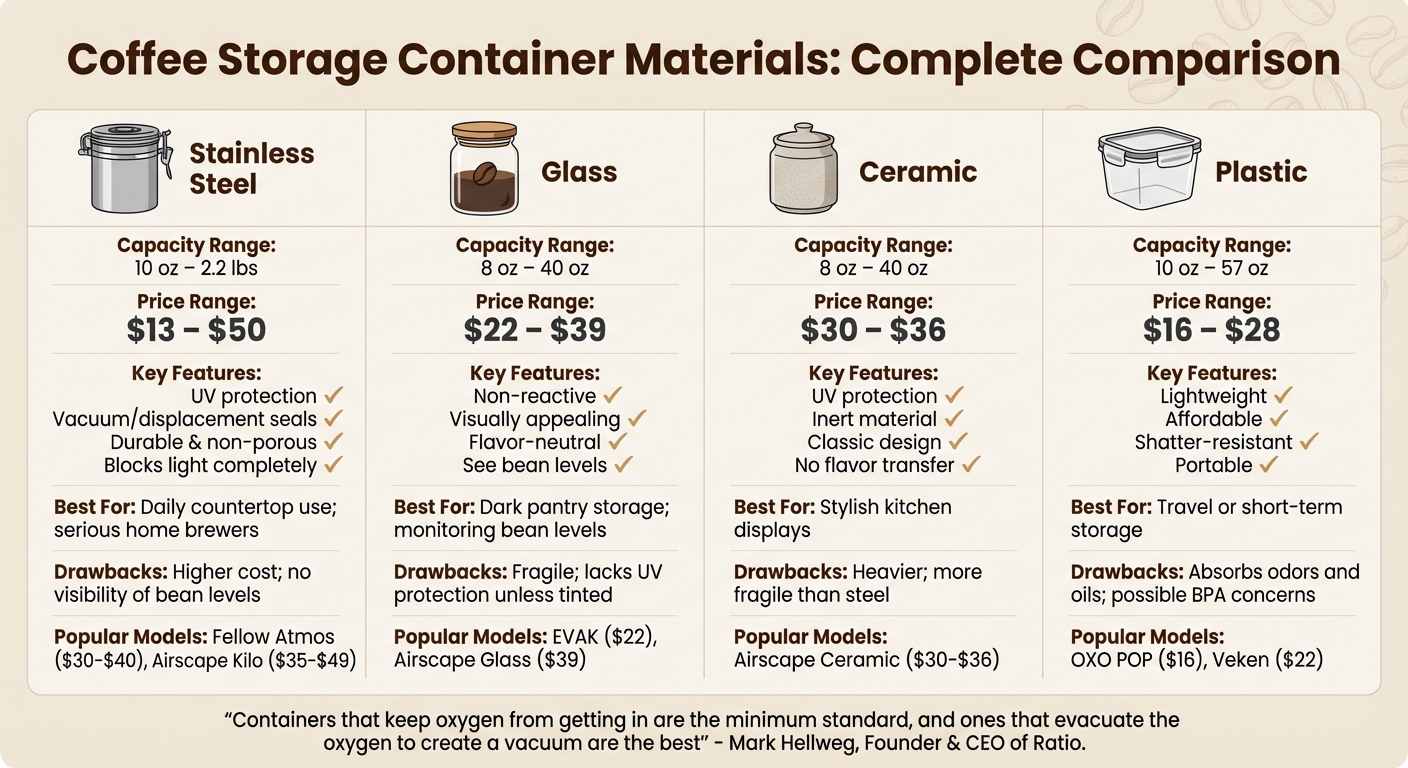
Coffee Storage Container Materials Comparison Guide
Comparison Table
Here’s a quick side-by-side breakdown of popular coffee storage containers to help you decide which one fits your needs.
| Material | Capacity Range | Price Range | Key Features | Best For | Drawbacks |
|---|---|---|---|---|---|
| Stainless Steel | 10 oz – 2.2 lbs | $13 – $50 | UV protection, vacuum or displacement seals, durable, non-porous | Daily countertop use; serious home brewers | Higher cost; no visibility of bean levels |
| Glass | 8 oz – 40 oz | $22 – $39 | Non-reactive, visually appealing, flavor-neutral | Dark pantry storage; monitoring bean levels | Fragile; lacks UV protection unless tinted |
| Ceramic | 8 oz – 40 oz | $30 – $36 | UV protection, inert material, classic design | Stylish kitchen displays | Heavier; more fragile than steel |
| Plastic | 10 oz – 57 oz | $16 – $28 | Lightweight, affordable, shatter-resistant | Travel or short-term storage | Absorbs odors and oils; possible BPA concerns |
Stainless Steel containers are a top-tier option. For instance, the Fellow Atmos Vacuum Canister (priced around $30–$40) features a twist-activated vacuum pump, while the Airscape Kilo (approximately $35–$49) uses displacement technology to store up to 2.2 lbs of coffee beans, making it ideal for bulk purchases.
Glass containers like the EVAK (around $22) and Airscape Glass (about $39) let you keep an eye on your coffee supply but need to be stored in a dark space to avoid UV exposure.
Ceramic options, such as the Airscape Ceramic (priced between $30 and $36), combine light protection with a timeless look, making them perfect for kitchen displays. However, they’re heavier and more prone to breaking compared to other materials.
Plastic containers provide a budget-friendly and portable choice. The OXO POP (around $16) includes a one-way degassing valve and a sturdy build, but plastic’s tendency to absorb oils can affect coffee freshness over time.
Mark Hellweg, Founder and CEO of Ratio, highlights the importance of proper sealing:
"Containers that keep oxygen from getting in are the minimum standard, and ones that evacuate the oxygen to create a vacuum are the best" [4].
For on-the-go storage, the MiiR Airtight Coffee Canister (around $35) combines durable metal with a compression seal, while the Veken Coffee Canister (about $22) stands out for its built-in date tracker and over 9,000 five-star Amazon reviews.
Coffee Storage Best Practices
Ideal Storage Conditions
To keep your coffee fresh, aim for a temperature range of 50°F–70°F. This sweet spot slows down the chemical reactions that can rob your coffee of its flavor over time. Placing your coffee near heat sources, like stoves or ovens, causes temperature swings that speed up oxidation. Similarly, direct sunlight or bright kitchen lights can trigger photooxidation, breaking down the aromatic oils that give coffee its distinct flavor [3][10].
The best approach? Store your coffee in a dark, dry place, away from heat and light. For daily use, avoid refrigeration or freezing. Opening a cold container repeatedly can lead to condensation, which damages the beans and introduces unwanted moisture [10]. If you need to freeze coffee for long-term storage (over a month), portion it into small, airtight bags. Freeze them only once, and let them thaw completely to room temperature before opening [10].
These steps also help protect your coffee from unwanted flavor contamination, which we'll dive into next.
Preventing Flavor Contamination
Coffee beans are highly porous, meaning they readily absorb surrounding odors. Storing them near strong-smelling foods - like onions, fish, or spices - can ruin their flavor [8].
"Coffee is like a sponge: Once it's been processed, it's dry, coarse, and absorbent... in the freezer, it will start to absorb the flavors floating around in there" [8].
The type of container you use also plays a big role. Stainless steel and ceramic containers are excellent choices because they resist absorbing odors, unlike plastic [6]. If you switch between different roasts - say, a bold dark roast and a delicate light roast - make sure to wash and dry your container thoroughly to avoid cross-contamination [6].
Keeping your storage container clean is just as important as keeping it sealed. Regularly wipe down silicone gaskets with a damp cloth to remove coffee dust or oils that could compromise the airtight seal [4]. If you’re using plunger-style containers like the Airscape, fully press down the inner lid to minimize air exposure [6]. These small steps can make a big difference in preserving your coffee’s flavor.
Fwing Coffee Storage Solutions
Fwing Coffee Storage Container Options
Fwing Coffee has developed storage solutions that aim to keep your coffee fresher for longer. Their storage containers use a patented inner plunger lid that actively pushes air out before sealing. This plunger sits directly on top of your coffee beans, reducing the "dead air" space that speeds up oxidation [6][7].
What makes this system even smarter is the inclusion of a one-way CO₂ valve, which allows carbon dioxide to escape without letting air in [6][7][15]. To ensure an airtight seal, premium silicone gaskets are used on both the inner plunger and the outer lid [6].
When it comes to materials, Fwing Coffee opts for stainless steel and ceramic. These materials are non-porous, meaning they resist absorbing old coffee oils and help prevent flavor contamination. Whether you're storing a robust dark roast or a delicate light roast, these surfaces help maintain your coffee’s original flavor profile [1].
Benefits of Fwing Coffee Products
Fwing Coffee’s containers aren’t just well-designed - they’re practical for everyday coffee lovers. The adjustable plunger system significantly reduces air exposure, making it ideal for both bulk storage and daily use by slowing down oxidation [6][16][17].
With durable materials, airtight seals, and thoughtful engineering, these containers ensure your coffee stays fresh from the first scoop to the last. They align with Fwing Coffee's broader commitment to offering high-quality tools and accessories that elevate your brewing experience without adding unnecessary complications.
Conclusion
Storing coffee the right way is essential for maintaining its flavor. A well-chosen coffee storage container can make a noticeable difference. Did you know that coffee can lose up to 70% of its flavor within just two weeks when exposed to oxygen repeatedly? And yet, about 90% of in-home coffee isn't stored properly [1].
The best containers protect coffee from oxygen, light, heat, and moisture. Vacuum-sealed or air displacement containers are especially effective at keeping air out, while opaque materials like stainless steel or ceramic block harmful UV rays that can break down coffee oils. As Mark Hellweg, Founder and CEO of Ratio, explains:
"Containers that keep oxygen from getting in are the minimum standard, and ones that evacuate the oxygen to create a vacuum are the best" [4].
Where and how you store your coffee matters just as much. A cool, dark, and dry spot is ideal for storage. Use a container that's appropriately sized to reduce empty space [1][14]. And always store whole beans, grinding only what you need right before brewing.
Whether you go for a simple airtight canister or invest in a premium vacuum-sealed system like those from Fwing Coffee, the goal remains the same: to preserve the quality and flavor that the roaster worked hard to achieve. With the right storage practices, every cup you brew can taste as fresh and flavorful as intended [1].
FAQs
Why is vacuum sealing essential for storing coffee?
Vacuum sealing plays a crucial role in keeping coffee fresh by reducing its exposure to oxygen. Oxygen is the main factor responsible for oxidation, a process that gradually robs coffee of its flavor, aroma, and overall quality.
When you vacuum seal coffee, you remove the air from its container, creating a barrier that slows down oxidation. This helps maintain the coffee's rich flavors and aromas much longer than other storage methods. For example, keeping coffee in clear containers or even in the freezer leaves it vulnerable to air, light, and moisture, all of which can harm its quality.
For anyone passionate about their coffee, vacuum sealing is an excellent way to ensure your beans stay fresh and full of flavor until you're ready to brew your next cup.
What makes ceramic containers a good choice for storing coffee?
Ceramic containers are a solid choice for coffee storage, thanks to their distinct advantages. One standout feature is that ceramic is non-reactive, so it won’t soak up odors or flavors. This means your coffee retains its original taste without any unwanted interference. Plus, most ceramic containers are opaque, offering a shield against sunlight that can break down your coffee’s flavor over time.
Another perk? Many ceramic containers come with airtight seals, which block oxygen from reaching your coffee. This slows down oxidation, ensuring your beans or grounds stay fresh longer. With their long-lasting build and protective features, ceramic containers offer a practical and stylish way to keep your coffee at its best.
How does exposure to light affect the freshness of coffee?
Exposure to light, particularly UV rays from sunlight or intense artificial lighting, can rapidly diminish coffee's freshness. Light speeds up oxidation, which breaks down the delicate oils and aromatic compounds that give coffee its rich flavors and enticing aroma. The result? A flat, stale taste that lacks the vibrancy coffee lovers crave.
To maintain that fresh, flavorful profile, store your coffee in opaque, airtight containers. These containers shield the coffee from light while also protecting it from other culprits like oxygen, heat, and moisture. With proper storage, you can extend the life of your coffee's flavor and aroma, making every cup as satisfying as the first.